







Operating as a critical national infrastructure in South Yorkshire, the COMPASS facility marks a new era in composite materials manufacturing by moving beyond traditional, manual processes in the aerospace sector. Built on two decades of composite and automation research at the University of Sheffield AMRC, this open-access R&D site removes high cost-barriers for businesses, ranging from small and medium-sized enterprises (SMEs) to global aerospace leaders, enabling them to compete in global supply chains.
Global aerospace giant Boeing is the facility's first industrial user. Boeing is launching the IHSS (Isothermic High-Rate Sustainable Structures) project at COMPASS, representing its largest research initiative ever delivered in the UK. Backed by funding through the government's ATI Programme, the project aims to develop lighter commercial aircraft structures and support aviation's commitment to net-zero carbon emissions by 2050, while dramatically reducing large component manufacturing times from approximately 40 hours down to just 4.
A Fleet of Robots and the World's Largest RTM Press
The advanced industrial equipment within the facility was funded through a £29.5 million grant from the ATI Programme, a partnership between the Aerospace Technology Institute (ATI), Department for Business and Trade, and Innovate UK. Key technical features of the facility include:
2,400-Tonne RTM Press: Built by Austrian manufacturer Langzauner and reported as the world’s largest for integral aerostructural parts, the resin transfer molding press boasts a 2,400-tonne pressing force and a tool size of up to 10 × 3 meters.
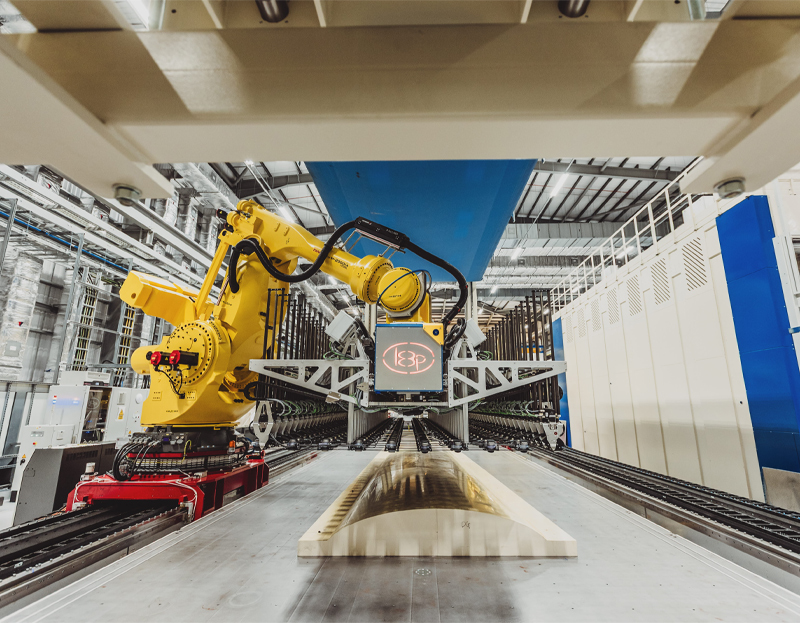
Ultra-High-Rate Robotic Preforming (FibreLINE): Developed by Loop Technology, the automated FibreLINE deposition system enables high-rate composite preforming. Loop also serves as the robotic systems integrator, delivering a fully sequenced, end-to-end manufacturing solution.
85-Meter Robotic Track: Operating adjacent to a 21.4-meter Zünd cutting table, the cell houses a five-robot fleet from FANUC. Two massive robots equipped with 5-meter FibreFORM grippers handle delicate materials, supported by three additional FANUC robots along an 85-meter track. The fleet uses real-time sensor data to dynamically adapt to material behavior during the high-rate build process.
Industry 4.0 and Digital Twin: Manufacturing cycles are continuously optimized using closed-loop machine vision and digital twin modeling to reduce material waste, component weight, and defects.
TRL 6 De-Risking and Cross-Sector Application
By proving these advanced capabilities at Technology Readiness Level 6 (TRL 6), COMPASS de-risks high-rate manufacturing for the entire supply chain before full-scale commercial adoption.
Prof. Ben Morgan, CEO at the University of Sheffield AMRC:
"COMPASS represents a world-leading capability built on two decades of composites and automation research at the AMRC. To maintain the UK’s position as a leading aerospace manufacturing nation, we must de-risk and scale up new technologies. This facility will do just that."
Alun Reece, CEO of Loop Technology:
"It is immensely rewarding to see COMPASS open its doors. From the initial concept in 2019, this project has demanded vision and commitment from all partners. Today, we are one step closer to achieving our goal of manufacturing composite aerostructures at speed and scale."
The high-rate automation and sustainable composite innovations developed at COMPASS are expected to extend far beyond aviation, offering cost-effective component solutions across urban air mobility (UAM), wind energy, defense, and ground transportation.