



Established in 2005, the design competition has distributed over £1.5 million in total prize capital to more than 400 student inventions worldwide. In its 21st year, the award honored engineering solutions addressing hidden physical and physiological risks.
Sustainability Winner: Sentinel (Philippines)
Invented by Aldrei Ong, a structural engineering graduate from De La Salle University, Sentinel identifies internal structural vulnerabilities in buildings following seismic events to pinpoint collapse hazards.
Mechanism: Sentinel converts the standard concrete spacer block—traditionally used to position rebar reinforcement—into a sensor manufactured from self-sensing concrete embedded with conductive materials. When microcracks or internal fractures develop, changes in electrical resistance are detected via integrated electrodes and relayed wirelessly to an online monitoring dashboard.
Unit Cost and Scalability: Estimated at a manufacturing cost of 10 Philippine pesos (roughly 7.50 Turkish Liras) per unit, the sensor installs seamlessly during the construction phase without requiring supplementary structural members.
Testing and Scale: Developed through graduate research involving the formulation and load testing of more than 125 concrete batches, Sentinel sensors are currently deployed in an active building in the Philippines. Following the award, Ong plans to transition prototype wiring to custom printed circuit boards (PCBs) and design retrofit solutions for existing buildings.
Medical Winner: Rumble Rims (United States)
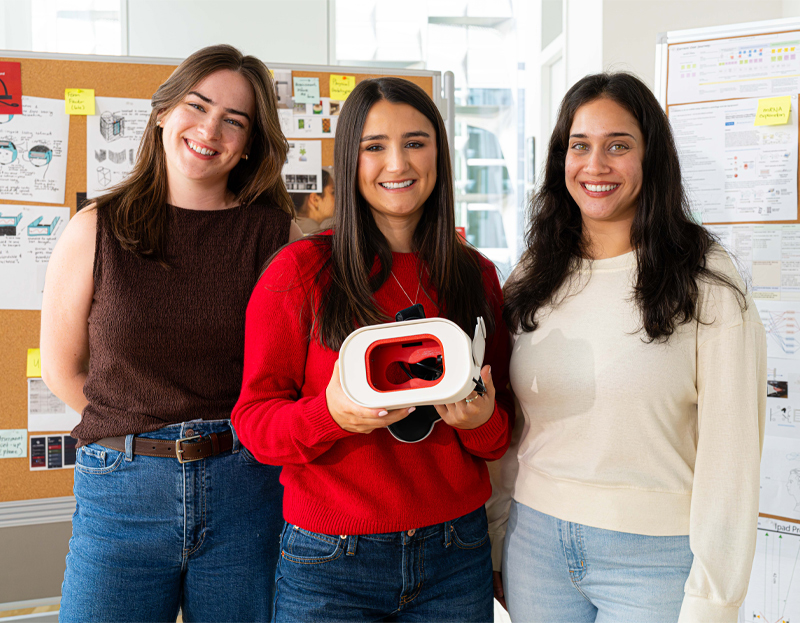
Developed by Harvard University researchers Radhika Saran, Cleo Pontone, and Sophia DeVito, Rumble Rims provides objective sideline concussion screening to protect athletes from the compounded risks of undetected brain trauma.
Mechanism: The low-cost headset utilizes side-mounted infrared cameras and 45-degree dichroic mirrors to assess eye-tracking, gaze fixation, and ocular dynamics during a 2-to-3-minute protocol. An accompanying mobile interface processes ocular telemetry into real-time indications to assist removal-from-play decisions and clinical referrals.
Screening vs. Diagnosis: Functioning as a non-diagnostic triage tool, Rumble Rims features a post-game monitoring dashboard allowing serial assessments to provide families and clinicians with an objective log before return-to-play clearance is granted by medical professionals.
Next Steps: The team plans to build advanced prototypes, refine eye-movement analytics, validate the system with coaches and clinicians, and launch pilot deployments across educational athletic programs.

Leadership and Academic Commentary
Sir James Dyson (Founder of Dyson):
“This year’s international winners, Sentinel and Rumble Rims, tackle serious threats to life and health with remarkably simple ideas. These inventions could save lives. This is exactly the kind of bold thinking I hoped to encourage when I started the James Dyson Award 21 years ago. Both are thoroughly deserving of this recognition.
After an earthquake, critical damage inside a reinforced concrete building may not be visible to the naked eye and can lead to fatal consequences. Aldrei’s Sentinel cleverly turns an existing construction component into a low-cost sensor that detects cracking and provides early warning of damage. It could spot problems before they become costly and, crucially, keep people from living or working in buildings at risk of collapse.
We hear all too often of athletes suffering concussions and enduring life-altering consequences. Yet assessing concussions is complex, requiring specialized equipment and hospital expertise, meaning screening isn’t always available when needed. Cleo, Radhika, and Sophia found a new way to bring objective screening directly to the sidelines where critical calls are made. This invention could help prevent the lasting brain damage that affects so many athletes.”
Aldrei Ong (Inventor of Sentinel):
“Becoming the international Sustainability Winner of the James Dyson Award means a great deal to me. It is not just about the impact Sentinel can make, but also a reflection of what perseverance, curiosity, and continuous refinement can achieve. This recognition gives me confidence to continue advancing Sentinel to make structures safer.”
Dr. Bernardo Lejano (Professor of Structural Engineering, De La Salle University):
“I am thrilled that Aldrei pursued his graduate research in self-sensing concrete to develop an innovative, sustainable structural health monitoring system. I believe it will not be long before Sentinel becomes an essential component of reinforced concrete structures, enabling rapid safety assessments.”
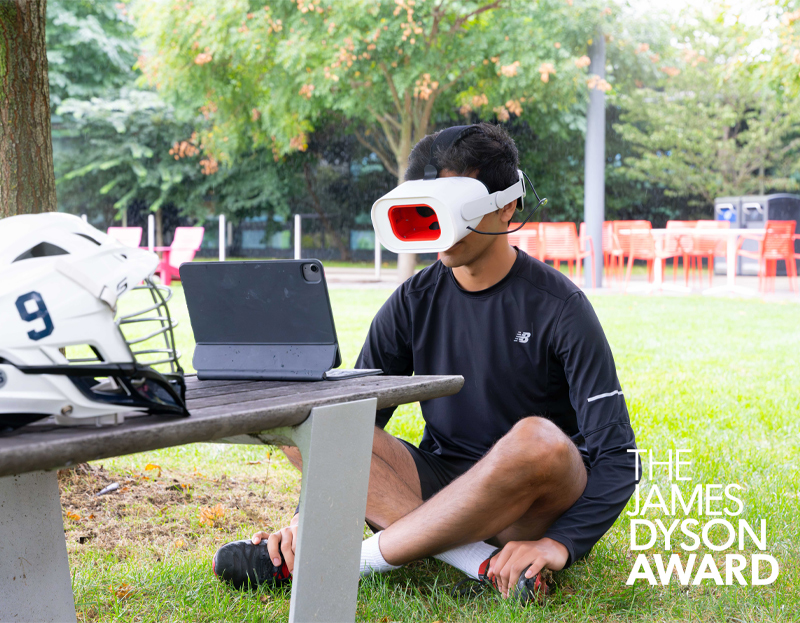
Cleo Pontone, Radhika Saran, and Sophia DeVito (Creators of Rumble Rims):
“Being recognized by the James Dyson Award reinforces our conviction that we do not have to accept problems as they stand. We have normalized concussions in youth sports despite their long-term neurological fallout. This award gives us the opportunity to move toward pilot programs that could bring Rumble Rims to sidelines everywhere.”
Shuya Gong (Lecturer in Design Engineering, Harvard University):
“What impressed me most about Cleo, Sophia, and Radhika was that while finding ways to test ambitious ideas through rapid prototyping, they never lost sight of making their solution accessible and easy to use on the sideline and at home. Rumble Rims brings together human-centered design and disciplined engineering.”
Corporate Profiles
About the James Dyson Award
In its 21st year, the James Dyson Award is an international design competition that celebrates and inspires next-generation design engineers. Administered by the James Dyson Foundation, the competition has supported over 400 student-led problem-solving inventions across 28 countries and territories with more than £1.5 million in total prize funding.
About the James Dyson Foundation
Established in 2002 in the United Kingdom, the James Dyson Foundation supports engineering, design, and technology education programs globally, including in the UK, the US, Japan, Singapore, the Philippines, and Malaysia. To date, Sir James Dyson and the Foundation have contributed over £155 million to charitable causes, including £12 million to establish the Dyson School of Design Engineering at Imperial College London, £8 million for the Dyson Centre for Engineering Design and the James Dyson Building at the University of Cambridge, and £7.8 million for the STEAM Centre expansion at Malmesbury Primary School.