






Fragrance, held at a "protective and functional" boundary under the grip of miasma theory and moral censorship in Medieval Europe, undergoes a radical paradigm shift during the Renaissance. In this era, scent transcends being a mere shield against disease; it evolves into an artistic expression, a symbol of social superiority, and a field of refined chemical knowledge. The Renaissance marks the threshold where scent detaches from the body, becomes an object, and is reborn as an "aesthetic signature."

Technical Revolution: The Rise of Alcohol and the Liberation of Scent
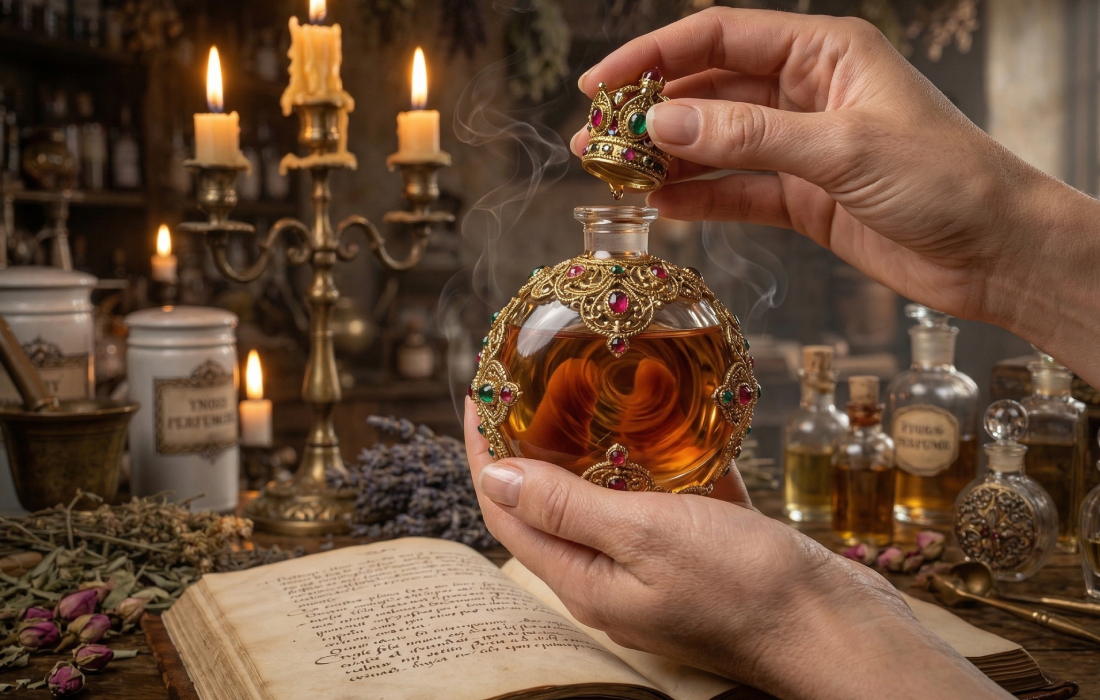
The oil-based unguentum culture of Ancient Rome and the herbal incenses of the Middle Ages were replaced by alcohol-based solutions in Renaissance workshops, fundamentally altering the nature of perfumery. The integration of alcohol (then known as aqua vitae) as a solvent shifted the way scent "clung" to the skin from a mechanical level to a chemical one:
-
Volatility and Sillage: While oil traps scent molecules on the surface, alcohol acts as a vehicle that carries these molecules into the air. Thus, fragrance gains independence from the individual, creating the first "sillage" (scent trail) that permeates the environment.
-
Aqua Mirabilis (Miraculous Waters): These mixtures distilled with alcohol moved perfumery away from being a branch of pharmacy and closer to the modern understanding of the fragrance pyramid. The famous "Hungary Water" of the 14th century, the first great marriage of rosemary and alcohol, laid the foundation for the Renaissance ideal of clear, volatile scent.
Focus: Chemistry – The Carrier Phase Revolution
While the vegetable oils of antiquity (olive, almond, etc.) only physically trapped scent molecules, the ethyl alcohol (ethanol) that became widespread in the Renaissance chemically dissolves them. Alcohol's low boiling point and high volatility allow scent molecules to disperse into the air in a controlled manner, making the phenomenon of "sillage" (scent trail) possible for the first time.
Scented Gloves: The First Dance of Fragrance with Fashion and Chemistry
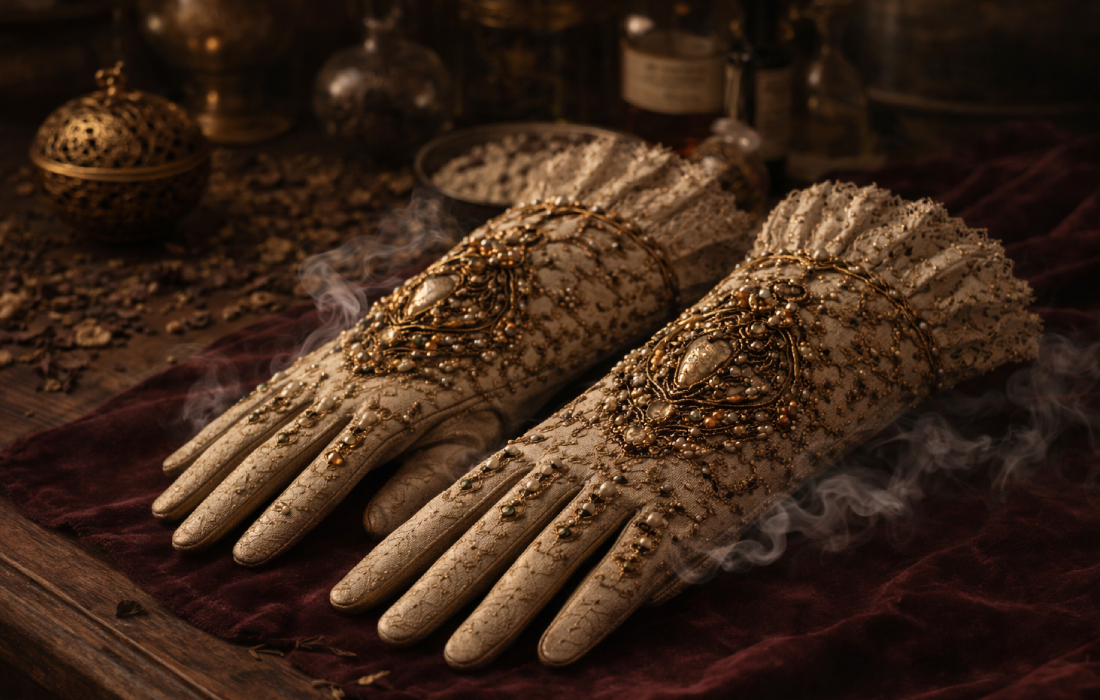
The first structural bond between scent and fashion in the Renaissance was established through the heavy odor of the leather industry, though it may sound strange today. Here, the functional scent understanding of the Middle Ages transformed a technical necessity into an aesthetic luxury. Guilds of "Gantiers Parfumeurs" (Perfumer-Glovers) were established to suppress the pungent odors of animal fat, urine, and lime used in the tanning process.
Fragrance was subjected to a technical operation as a "masking art":
-
Maceration and Scenting: Leather gloves were soaked for weeks in oily solutions containing jasmine, rose, and amber. Scent molecules became trapped within the pores of the leather.
-
Signature and Status: This tradition, carried from Italy to the French courts by Catherine de' Medici, transformed scent into a social power that lingered on everything touched. Nobility was no longer just a visual spectacle but a fragrant legacy left on every object.
Focus: Chemistry – Organic Masking
The odors of ammonia and heavy metals produced during the tanning process are basic in nature. The acidic plant essences and resins used by perfumers penetrate the leather fibers (collagen structure) to neutralize these odors. This process is not merely masking; it is the establishment of a permanent bond between the leather's chemical structure and the aromatic compounds.
A Graceful Threat: The Dark Side of Perfume
However, this elegance was not always innocent. In the court intrigues of the Renaissance, scent functioned as both a shield and a hidden weapon. The legend of "poisoned gloves" summarizes the uncanny power of perfumery in this era. The potent aroma of perfume was used not only to mask the smell of leather but also the scent of lethal poisons that seeped through the skin. The narrative of Catherine de' Medici eliminating her enemies through this method highlights how strategic and fearsome a tool fragrance became. Scent was no longer just an essence that elevated the soul; it was the silent and deadly partner of power.
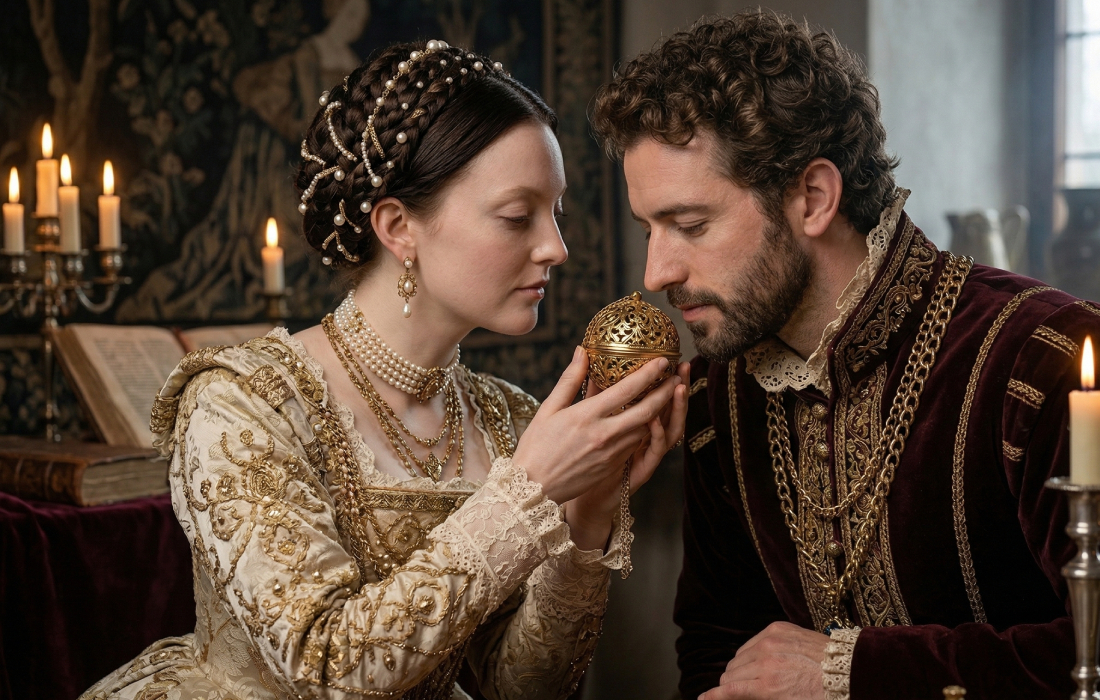
Mechanical Design: Pomanders and the Objectification of Scent
The pomander, carried as a protective amulet in the Middle Ages, transformed into a marvel of engineering and jewelry in the Renaissance. These apple-shaped metal spheres were now composed of segments, each allowing for the storage of a different note (musk, amber, cinnamon).
This transition proves that fragrance was positioned as an added "status object" rather than a bodily secretion:
-
Personalized Layers: Users began to "manually" control their olfactory experience for the first time, choosing which segment to open based on their mood or the social gathering.
-
Fragrance as an Accessory: Scent was now found in jewelry, belts, and even buttons; humans began to construct their own scent externally, much like a painting.
Conclusion
As a result, Renaissance Europe rescued fragrance from the axis of "sin and disease," defining it as an intellectual pleasure and an art object, thus laying the foundations of modern perfumery. Scent was no longer a part of the body, but a cultural shield surrounding it.
Source
Araştırmacı Editör: Öykü Nur Yüce