







For many years in the chemical industry, the primary production model has been batch processing, where raw materials are loaded into large reactors, reacted for a specific time, and then discharged and cleaned. However, under current market conditions, rising energy costs, tightening environmental regulations, and millisecond quality sensitivities are forcing the sector into a radical transformation.
At the center of this transformation are Continuous Processing, also known as Flow Chemistry, technologies, where raw materials are fed into the system continuously and the product is withdrawn constantly. So, how exactly is this process technology, supported by microreactors and smart automation, transforming the chemical sector?
1. From Batch to Flow Chemistry: Differences in Operating Logic
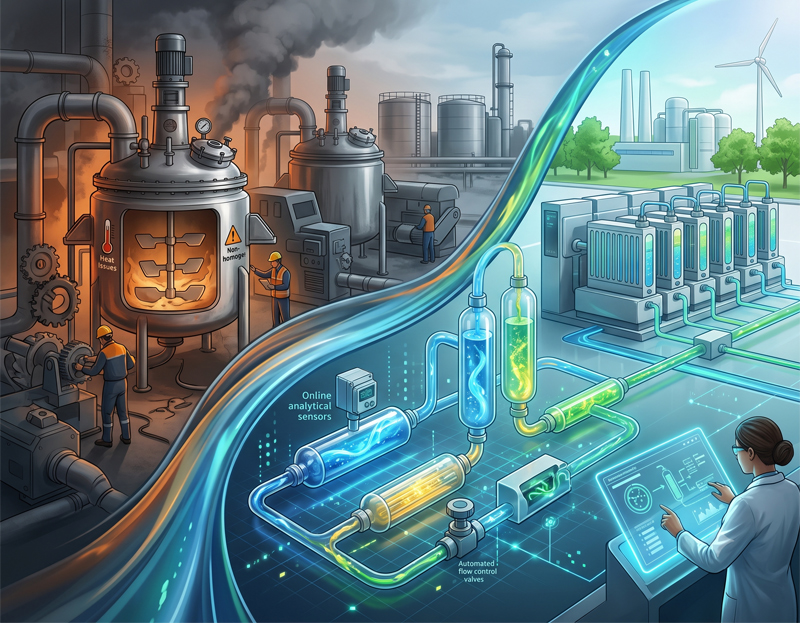
In traditional production, reacting tons of chemicals in the same vessel creates severe challenges in terms of heat transfer and homogeneous mixing. In continuous processing, reactions take place in specially designed micro- or meso-channel reactors instead of huge vessels.
High Heat and Mass Transfer: As the reaction volume shrinks, the surface area per unit volume expands. This allows exothermic (heat-releasing) reactions to be controlled instantly.
Steady-State Operation: Once the system enters regime, product quality remains constant regardless of time. Quality fluctuations encountered in every batch are eliminated.
2. Sectoral Advantages of Continuous Processing Technology
The spread of continuous processing technologies provides facilities with not only technical but also very serious economic and operational advantages.
A. Plant Safety and Risk Management
In hazardous or explosive reactions, the instantaneous amount of explosive raw material in the system (holdup volume) is thousands of times less than in batch processing. In the event of a loss of control, the risk remains at a micro level.
B. Energy and Space Efficiency (Process Intensification)
Compact (modular) flow systems replacing giant reactor vessels reduce the physical footprint of plants by up to 70%. The amount of energy spent on heating and cooling drops significantly.
C. Fast R&D and Ease of Scale-Up
In the traditional method, transitioning from lab scale to mass production (scale-up) involves months of trials because reactor geometry changes. In continuous production, to increase output, the reactor is not enlarged; identical modules are added side-by-side (numbering-up). This dramatically accelerates the "time-to-market."
3. Which Sectors Does It Stand Out In?
Continuous process technologies are becoming the standard, especially in areas requiring high value-added and precise chemical synthesis:
Pharmaceuticals and API Production: Enables reaching purity rates over 99% in delicate molecule syntheses.
Polymer and Resin Chemistry: Makes full control of polymerization degree and molecular weight distribution possible.
Fine Chemicals and Agrochemicals: Ensures hazardous nitration or fluorination reactions are conducted safely.
Industry 4.0 and Autonomous Chemical Plants
Continuous processing is not merely a mechanical equipment change; it is an Industry 4.0 transformation working integrated with artificial intelligence and in-line analytical measurement tools (NIR, Raman spectroscopy). These systems, where product quality is measured instantly inside the reactor and AI adjusts valves within milliseconds, form the cornerstone of future "dark (autonomous) chemical factories." For chemical manufacturers aiming for sustainability, occupational safety, and high efficiency in their plants, investing in continuous processing is no longer an option, but a necessity to remain competitive.