





Conducted between August 19 and September 3, 2026, using the Computer-Assisted Web Interviewing (CAWI) method, the survey sampled 1,003 participants aged 18–64 (average age 39) across 12 provinces aligned with NUTS-1 regional distribution. The findings confirm that relaxation is far more than a physical act; amid the fast pace of modern life, it begins with shedding mental burdens and shutting out external stimuli.
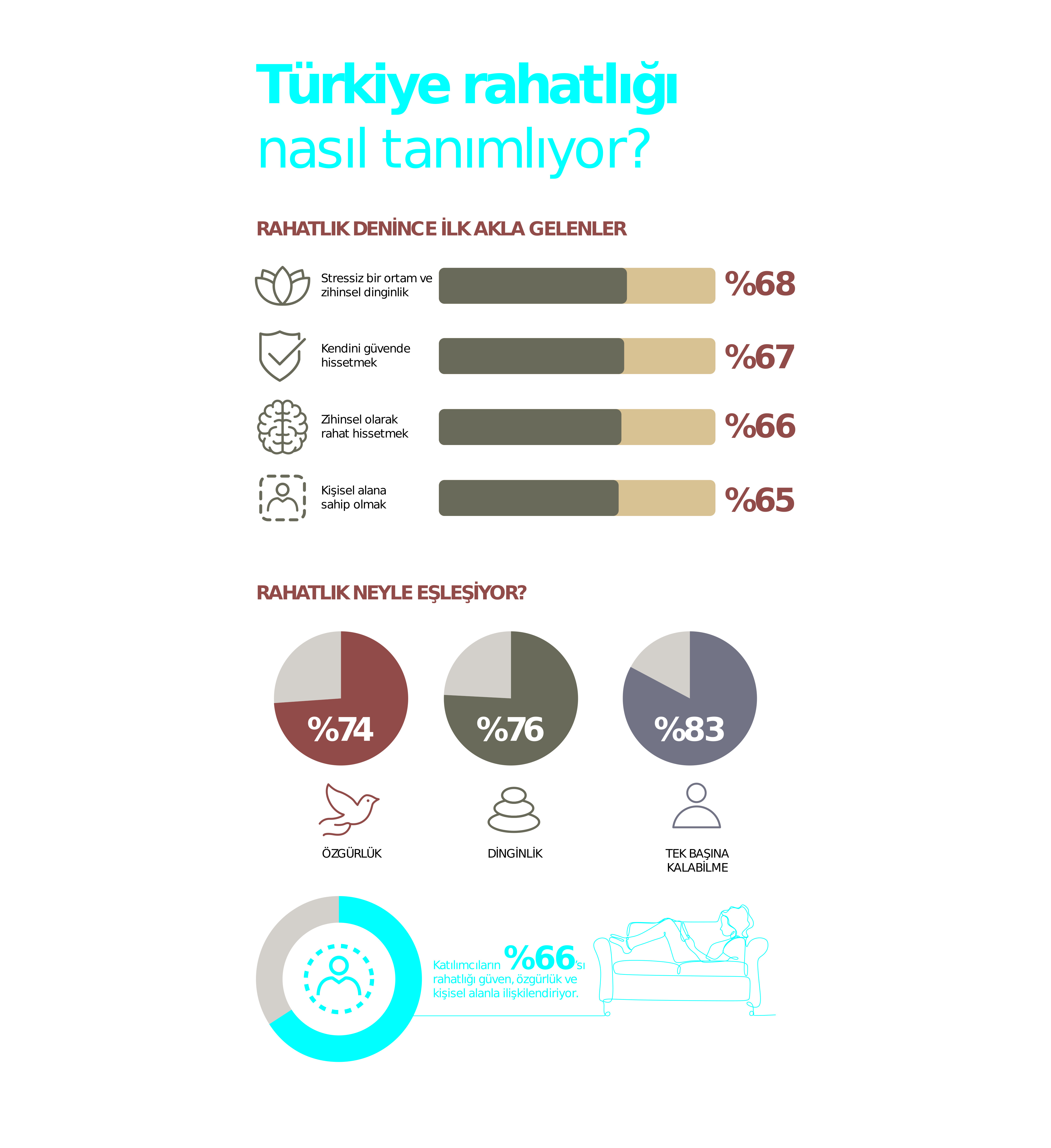
How Does Turkey Define Comfort?
According to the data, comfort for Turkish society begins when invisible mental burdens lighten rather than through purely physical ease. Top associations with comfort include a stress-free environment and mental calm (68%), feeling safe (67%), feeling mentally at ease (66%), and having personal space (65%). Furthermore, respondents link comfort with being able to be alone (83%), tranquility (76%), and the freedom to adjust conditions to their own needs (74%). Open-ended findings also underscore that freedom from financial anxiety and having a debt-free, steady income stream are indispensable prerequisites for mental peace.
Turkey’s 7:00 PM Dilemma and Productivity Pressure
An Average of 1.15 Hours of Uninterrupted Rest: While 55% of participants fail to find even one uninterrupted hour to relax daily, the national average stands at just 1.15 hours. For 71% of respondents, the day’s first real moment of relaxation is pushed past 7:00 PM (30% between 9:00 PM and 11:00 PM, and 22% after 11:00 PM), with Istanbul and Gaziantep recording the shortest uninterrupted rest durations.
Mental Guilt and the Restless Mind: Although 95% agree that rest is just as necessary as work, 89% believe they must finish all tasks before relaxing, and 87% view rest as a reward that must be earned. Moreover, 83% state that to-do lists continue running through their minds while resting, 80% interrupt their rest upon spotting an undone chore, and 66% feel guilty when sitting idle.
Metropolitan Burnout and the Center of Home Life: The Living Room and Sofa
While 72% of residents in Anatolian cities feel their city offers opportunities to relax, this rate drops to 60% in metropolitan areas (58% in Istanbul, 57% in Ankara), driven by traffic (36%), noise (36%), and crowds (35%). Barriers to relaxation also diverge by gender: women cite household chores (45%) and childcare (23%) as primary obstacles, whereas men point to financial concerns (48%) and workload (47%).
Seeking refuge from external chaos, 79% identify their home as the most comfortable environment, with 60% centering daily life in the living room:
2.3 Hours a Day on the Sofa: Participants spend an average of 2.3 hours daily on their favorite sofa—61% of that time lying down. Fully 91% define their sofa as their most private sanctuary at home, and 58% note that everyone in the household has a designated spot.
Sofa Rituals: Time on the sofa is most frequently accompanied by watching movies/series (52%), using smartphones/tablets (51%), and enjoying hot beverages (46%), while 43% fall asleep watching TV, 19% play video games, and 18% work on laptops.
Functional Consumer Expectations: In purchasing decisions, ergonomic body support and practical functions lead at 93%, followed by easy-to-clean, stain-resistant, and pet-friendly fabrics (92%), convertible bed functionality (88%), and modular designs (76%).