







Navigating elevated capital costs, regional volatility, and pricing pressures, the Turkish chemical industry generated $22.8 billion in exports between January and August 2026, marking a 4.6% expansion over the previous year's $21.7 billion. Following an all-time six-month high of $17.1 billion in H1, outbound shipments recovered in August to reach $2.7 billion.
Reiterating the industry's $35 billion year-end export projection, İKMİB Chairman Vefa İbrahim Aracı outlined a dual commercial strategy: preserving entrenched market positions across Europe while accelerating trade missions across the United States, the Gulf, Latin America, and Asia.
12.85% Growth Across Top 20 Destinations: Spain and Italy Lead
Trade data across priority geographic markets demonstrated solid demand:
Leading Destinations: Spain ranked first with $1.27 billion, followed by Italy ($1.26 billion), the United States ($1.04 billion), and Germany ($966 million).
Notable Surges: Shipments expanded by 47% to Spain, 163% to Malta, 129% to Morocco, approximately 60% to Georgia, and 34% to the United States.
Contractions: Deliveries decreased by 29% to Romania and roughly 25% to the Netherlands, accompanied by softer contractions in France, Russia, and Ukraine.
Operational Margins, Financial Liquidity, and Global Competition
Emphasizing the sector's reliance on high working capital and imported raw materials, Aracı raised key structural points:
Financing Accessibility: High borrowing costs constrain cash flow and delay capacity expansions, R&D projects, and decarbonization investments. Aracı emphasized tailoring Eximbank and rediscount loan tenors to match operational chemical cycles.
Cost/FX Dynamics: Increases in energy and domestic operational inputs outpaced foreign exchange rate adjustments, compressing margins against global price pressure.
Competitor Pressure: While China exercises downward pricing pressure through industrial overcapacity and Saudi Arabia leverages low-cost petrochemical feedstock, Turkey leverages operational flexibility, geographic proximity, and an extensive product matrix.
Iraq and Syria Surpass $970 Million: Transition to Direct Industrial Investments
Regional recovery in neighboring territories continues to provide momentum. Turkey exported $693.9 million in chemicals to Iraq and $280.4 million to Syria in the first eight months of 2026. Identifying acute demand for plastics, coatings, construction chemicals, and hygiene products, Aracı underlined that Turkish chemical firms will transition from merchandise suppliers to on-site production investors as regional banking, energy, and customs frameworks stabilize.
Regulatory Decarbonization and Support for SMEs
With frameworks such as REACH, CLP, the EU Carbon Border Adjustment Mechanism (CBAM), and packaging directives (PPWR) setting commercial terms, İKMİB is expanding advisory support to reduce testing, auditing, and compliance expenditures for Turkish SMEs.
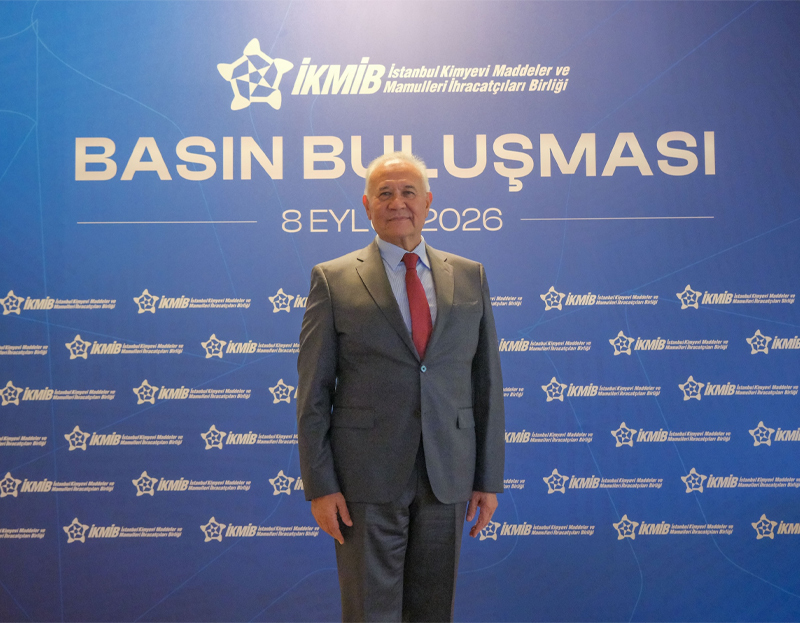
Statement from İKMİB Chairman Vefa İbrahim Aracı
“We have four critical months ahead of us. Despite global trade uncertainties, geopolitical risks, and production cost pressures, we place full confidence in our manufacturing infrastructure and export execution. In the final stretch of the year, we will intensify our efforts to expand our presence in existing markets, capture new territories, and prioritize high-value exports.
Europe will remain our primary market. However, global shifts mandate reinforced market diversification. Outsized gains in Spain and Morocco prove that substantial room for growth exists when targeting the right destinations. While defending our standing in Europe, we aim to accelerate diversification across the United States, the Gulf, Latin America, and Asia.
A deferred investment today directly equates to eroded competitive strength in foreign trade tomorrow. We anticipate the introduction of tailored financing tools specifically designed to back production, exports, and value-added manufacturing.”