





Parquet and engineered wood flooring, revered in interior design for their organic texture, acoustic comfort, and enduring beauty, can maintain their initial form for decades under proper care. Yet whether budget laminate or solid oak, these flooring systems face their most insidious enemy in moisture.
Rain drifting in through an overlooked balcony door, runoff from an overwatered planter, or humidity condensing along a bathroom threshold quickly produces seam ridges, edge lifting, and irreversible buckling. Many homeowners struggle to understand why wood distorts so rapidly beneath an apparently intact coat of high-grade varnish. The answer lies within wood's cellular biology and the vulnerable boundaries of protective coating chemistry.
The Nature of Wood: Hygroscopic Behavior and the Swelling Mechanism
Even after being harvested, kiln-dried, and milled, wood remains a living, dynamic material that continually exchanges moisture and ambient gases with its surroundings. Material scientists define this trait as hygroscopic behavior.
Water Storage in Cell Walls: The cellulose, hemicellulose, and lignin fibers constituting wood's primary structure are naturally predisposed to establishing hydrogen bonds with polar water molecules. When relative humidity rises or liquid water contacts these cellular bundles, wood fibers draw in moisture much like a sponge. As cells approach their fiber saturation point, they expand radially. When tightly interlocked planks lack clearance to accommodate this dimensional growth, they force each other upward, creating crown warping or edge buckling.
The Weakest Link in Laminate Flooring (The HDF Core): Unlike solid timber, common modern laminate planks rely on a core of high-density fiberboard (HDF). Because HDF is manufactured by compressing refined wood dust and resins, it expands even faster than solid wood upon moisture intrusion and cannot recover its dense factory form once dried.
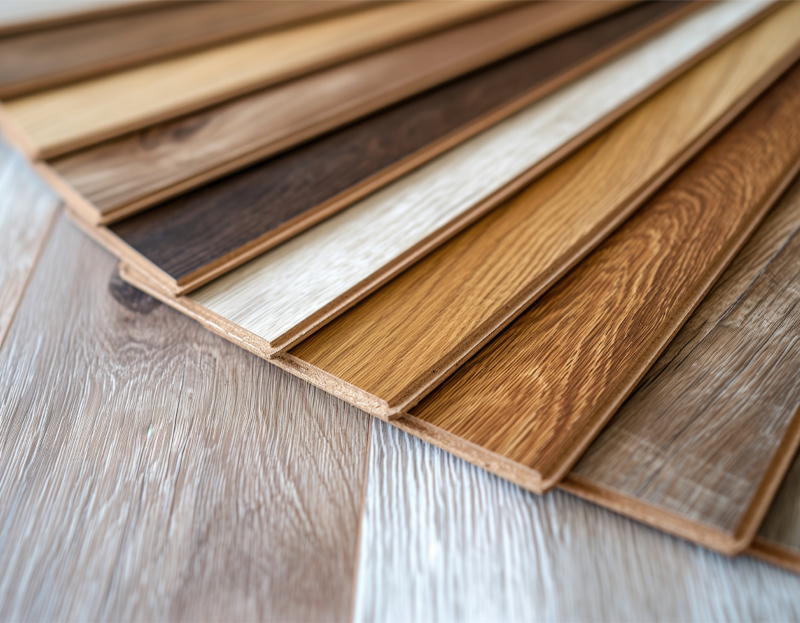
Chemistry of Wood Finishes and Protective Topcoats
The satin or glossy lacquer resting on floorboards serves not merely as a decorative veneer; it functions as a chemical shield against mechanical abrasion and daily stains. However, not all sealers offer identical moisture defense.
Water-Based and Solvent-Based Polyurethane Sealers: Polyurethane remains the industry benchmark for hardwood finishing. Upon curing, it cross-links into a continuous, flexible, and impermeable polymer film. Water droplets resting on this surface cannot penetrate the polymer matrix; surface tension keeps them beaded on top for hours.
UV-Cured Melamine and Aluminum Oxide Overlays: The top layer of laminate flooring consists of melamine resin reinforced with microscopic aluminum oxide particles. This layer is entirely water-impervious, easily deflecting red wine, coffee, or topical food spills without staining.
Why Do Floors Swell Despite Having Protective Finishes? The Seam Reality
If topcoat polymers and melamine resins are impervious to water, how does structural swelling happen? The vulnerability lies within the installation geometry between planks.
Protective coatings form a uniform horizontal barrier across the broad face of each plank. However, the tongue-and-groove click profiles and joint seams connecting adjoining boards frequently remain unsealed. When standing water is left unaddressed, capillary action draws liquid into these microscopic fissures.
Once moisture slips between the joints, it bypasses the surface finish entirely, contacting raw wood grain or the absorbent HDF core directly. While the top face repels the liquid, the substrate underneath expands aggressively, fracturing the finish from below. When floorboards buckle despite being varnished, it is the unprotected edges, not the topcoat, that have surrendered.
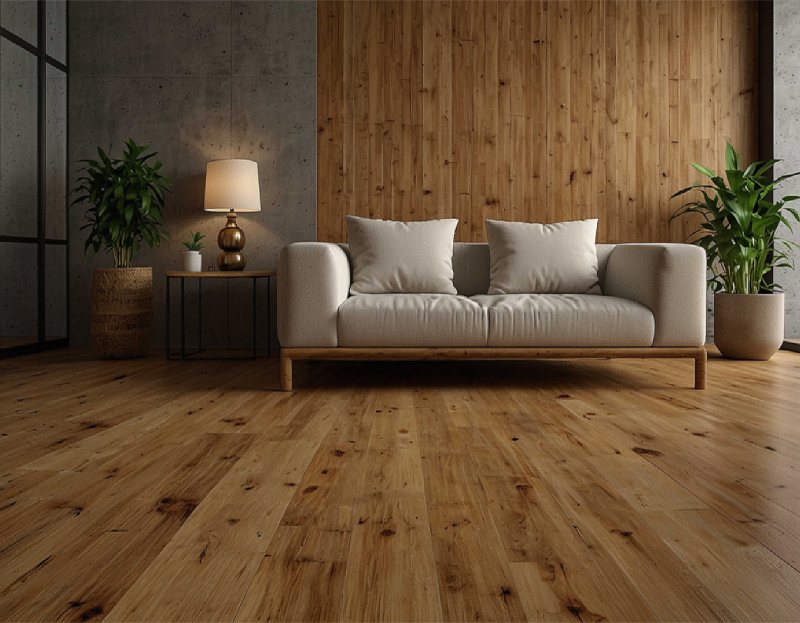
Preventing and Mitigating Water Damage on Parquet Floors
Preserving the dimensional stability and chemical integrity of wooden floors across their lifecycle requires discipline from installation to daily upkeep.
Joint Sealants and Edge Waxing: When laying floors adjacent to humid zones such as kitchens or entryways, installers should apply hydrophobic waxes or dedicated joint sealants along the click-lock tongue. These elastic compounds create a physical dam that blocks liquid from working into the seams.
Expansion Gaps Along Baseboards: Every wood floor installation requires a perimeter expansion gap of at least 10 to 15 millimeters concealed beneath baseboards. This buffer allows planks to expand naturally with seasonal humidity fluctuations without pressing against walls and buckling at the room center.
Moisture-Controlled Cleaning Protocols: Wooden floors should never encounter dripping-wet string mops. Mops must be wrung thoroughly until damp to the touch, paired with pH-neutral wood cleaners formulated to avoid degrading protective lacquers. Any accidental liquid spill must be blotted dry immediately before capillary forces pull it into seams.
In Summary
Floorboard swelling stems not from a defect in topcoat chemistry, but from wood's inherent affinity for moisture finding an open path through unprotected plank seams. Modern polyurethane finishes and melamine resins possess ample water repellency; the real challenge is extending that protection to joints and perimeter gaps. Thoughtful edge sealing, consistent humidity management, and swift cleanup habits remain the definitive defense for preserving the integrity of timber floors over the long run.