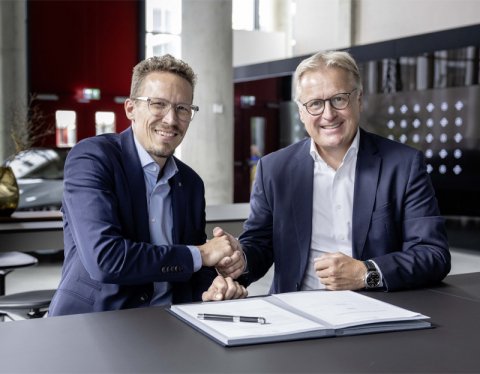








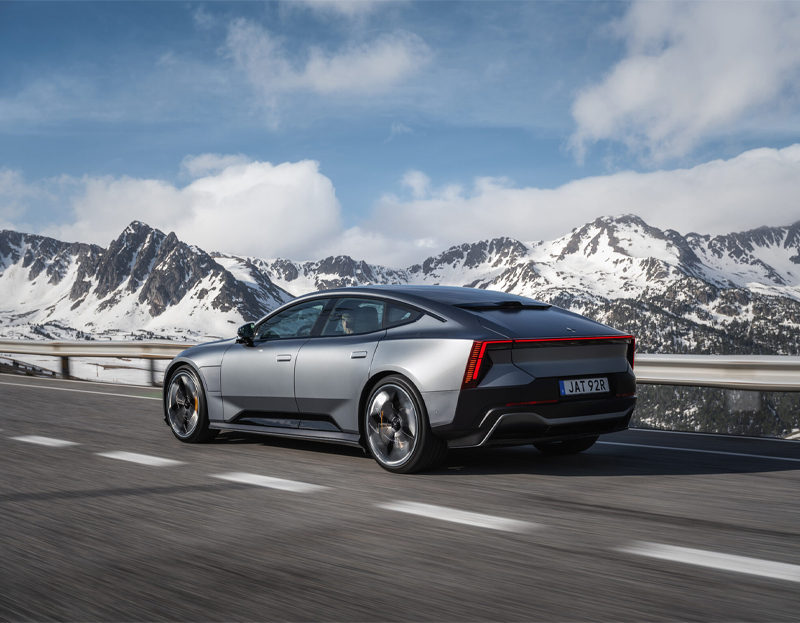
The strategic partnership between Swedish EV manufacturer Polestar and Swiss lightweighting specialist Bcomp—originally established through the development of the Polestar Precept concept car—has officially transitioned into large-scale series production with the new Polestar 5. Within the cabin, the engineering teams developed a bespoke, two-tone "Polestar Signature Weave" ampliTex flax fabric engineered to perform dual structural and aesthetic roles. By eliminating the requirement for extra lacquers, foils, or decorative trim, the component projects Polestar's minimalist design language directly through the natural composite's visible weave.
Lifecycle Footprint and Weight Reductions
According to Polestar's vehicle assessment, the Polestar 5 records a cradle-to-gate footprint of 23.8 tCO₂e—accounting for all emissions from initial raw material extraction right up to the factory exit gate. Substituting conventional interior thermoplastics with Bcomp’s flax composites yields measurable sustainability and operational advantages:
50% reduction in fossil-based raw material consumption,
Up to 40% weight savings versus traditional automotive plastics,
Up to 60% lower manufacturing-phase carbon emissions at the component level depending on parts geometry.
Polestar continues to publish transparent full lifecycle assessments across its model portfolio, benchmarking factory-gate emissions as a standard for future reductions across production runs.
Material Architecture: ampliTex™ and powerRibs™
The structural front seatbacks combine natural fibre polypropylene (NFPP) with Bcomp’s dual technologies:
ampliTex™: Mechanically processed European flax yarn woven into structural reinforcement textiles, requiring significantly lower embodied energy and process emissions than synthetic carbon or glass fibers.
powerRibs™: A 3D rib grid inspired by leaf venation, applied to the back of composite panels to maximize flexural bending stiffness. This allows engineers to manufacture components with a thinner gauge without sacrificing structural rigidity.
The natural composites are also built into the tailgate structure, fully satisfying automotive engineering benchmarks for crash safety, UV stability, scratch resistance, and long-term aging. At end-of-life, manufacturing offcuts can be compounded into pellets for injection molding applications, while thermoset variants allow for clean energy recovery from the material's stored biogenic carbon.

Executive Commentary
Per Martensson (Chief Revenue Officer, Bcomp):
"Working with Polestar over a number of years has given us the opportunity to show that the path from a material concept to a series-production component can be long and rigorous but is ultimately worth it. The Polestar 5 seatbacks have a combination of lightweighting performance, reduced carbon footprint, and design for end-of-life that conventional composites cannot offer."
Maria Uggla (Head of CMF Design, Polestar):
"The materials we use in our vehicles are important from their environmental impact as well as their performance aspects. With the Polestar 5, we aim for a performance-focused Grand Tourer, without compromising on our sustainability targets. Bcomp’s materials have allowed us to build a performance-focused seatback as well as not compromise our sustainability requirements."