







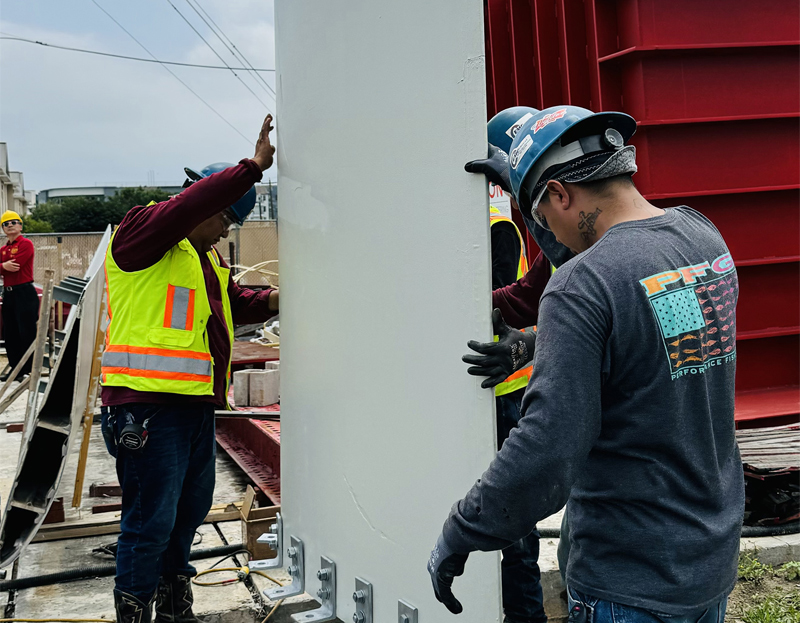
Wind power now provides roughly 10% of total U.S. electricity generation, but the success of the industry has created an impending end-of-life disposal challenge. Utility-scale turbine blades are typically engineered for service lifecycles of 20 to 25 years. With early fleets reaching retirement, estimates indicate that nearly 4 million tons of composite blade material will require end-of-life management in the United States alone by 2050.
Because crosslinked GFRP composites are inherently resilient, lightweight, and resistant to environmental degradation, conventional recycling methods remain cost-prohibitive and technically inefficient. As a result, decommissioned blades are commonly shredded into low-value aggregate, incinerated, or sent to landfills.
Mechanical Testing and FEA Structural Modeling
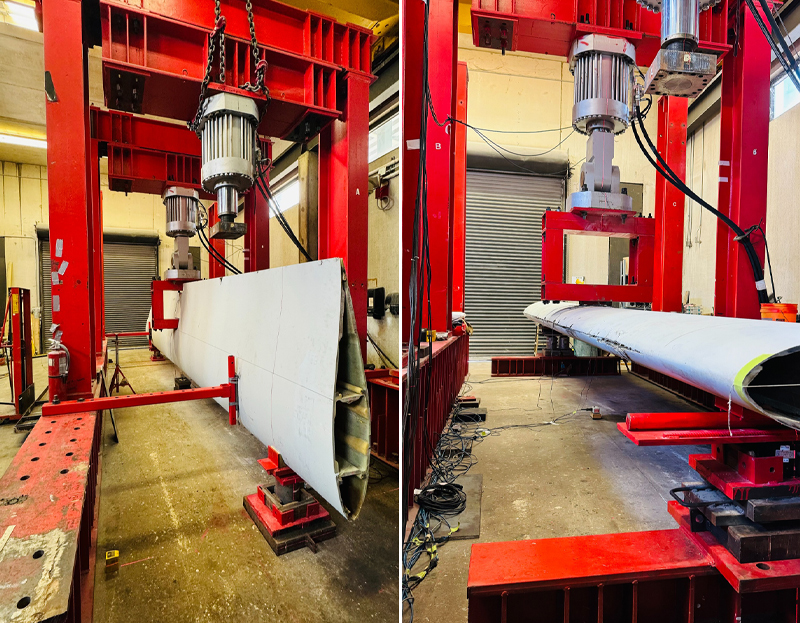
Rather than destroying the structural integrity engineered into the composites, the Houston team evaluated retired GE37 turbine blades supplied by Carbon Rivers. Material characterization focused on the primary load-carrying spar caps:
Residual Strength: Even after decades of continuous field operation, the spar caps retained tensile strengths approaching 90 ksi and compressive strengths near 54 ksi, proving that most of their initial load-bearing capacity remained intact.
Bending Evaluations: The team conducted full-scale destructive and non-destructive bending tests on 25-foot blade segments at the university's Thomas Hsu Structural Research Laboratory. Tested in both edgewise and flapwise orientations, the composite segments sustained high loads and demonstrated gradual, predictable deformation rather than sudden brittle failure.
Abaqus Finite Element Modeling: Because blade geometry and laminate thickness vary across different models, calibrated finite element models were created in Abaqus to simulate complex load distributions and pinpoint critical stress concentrations.
According to researchers, the main engineering hurdle was not the composite material itself, but designing customized connection systems. Unlike standard structural steel members that can be easily welded or bolted, GFRP blades required specialized mechanical connections capable of safely transferring heavy aerodynamic forces into ground foundations without crushing or delaminating the composite matrix.
AASHTO Compliance and Real-World Hurricane Validation
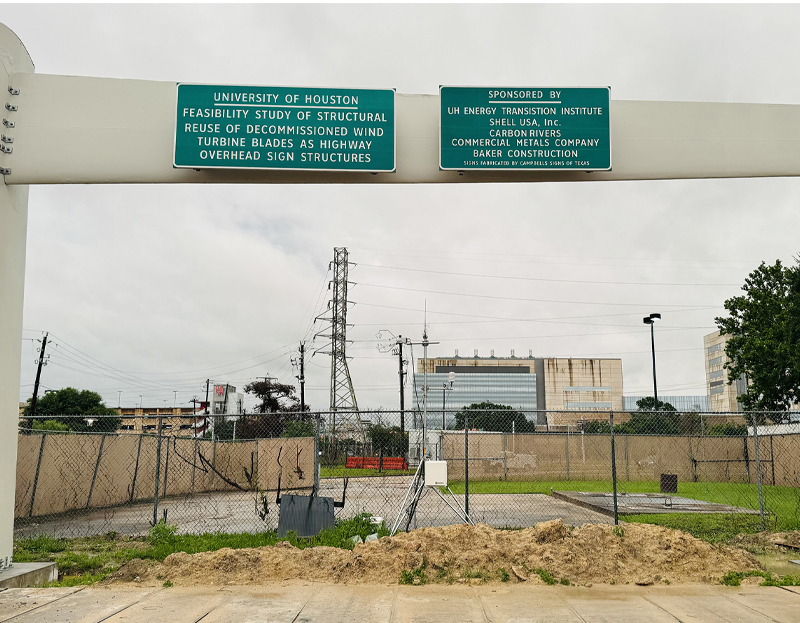
Highway overhead sign structures were specifically selected as the demonstration platform because they are governed by demanding wind-load criteria established by the American Association of State Highway and Transportation Officials (AASHTO).
The finished prototype spans approximately 40 feet and provides 18.5 feet of vertical roadway clearance. Repurposed blade segments serve as both the vertical support columns and the horizontal overhead chord, carrying the static weight of the sign panels while resisting lateral aerodynamic forces.
Shortly after installation, the prototype underwent an unprompted real-world extreme weather test in 2024, successfully withstanding a derecho and Hurricane Beryl, both of which generated localized wind gusts exceeding 100 miles per hour across the Houston area, without exhibiting structural damage or connection fatigue.
Compared with benchmark galvanized steel truss structures, the repurposed blade system achieved:
A 73% reduction in raw material procurement costs.
A more than 65% decrease in embodied energy and lifecycle greenhouse gas emissions.
The avoidance of roughly 248 metric tons of CO2 equivalent per installed gantry by extending the service life of existing engineered assets rather than producing primary steel and concrete.