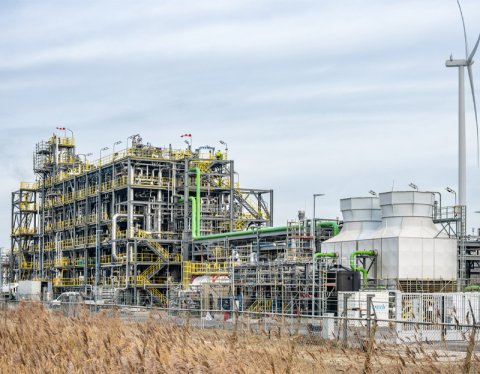








Installed in late 2025 and brought online in phases, the hydrogen burners represent one of Germany's first continuous industrial-scale applications running fully on hydrogen.
Technical conversions at the site included installing dedicated hydrogen pipelines, specialized burners, adapted control systems, and enhanced safety infrastructure.
Industrial Symbiosis and Side-Stream Integration
The hydrogen feedstock is sourced as a byproduct from chlor-alkali electrolysis at Covestro's neighboring facility and delivered directly via localized pipeline, avoiding long-distance transport and eliminating the need for dedicated hydrogen generation infrastructure.
The project builds on an established industrial symbiosis between Lanxess and Covestro at the historic Krefeld-Uerdingen complex:
Covestro supplies nitrobenzene to Lanxess for iron oxide pigment synthesis via the Laux process.
The resulting aniline byproduct is returned to Covestro as a raw material for polyurethane and plastics production.
Integrating byproduct hydrogen from chlor-alkali operations adds a third circular material link between the two chemical sites.
Executive Leadership Commentary
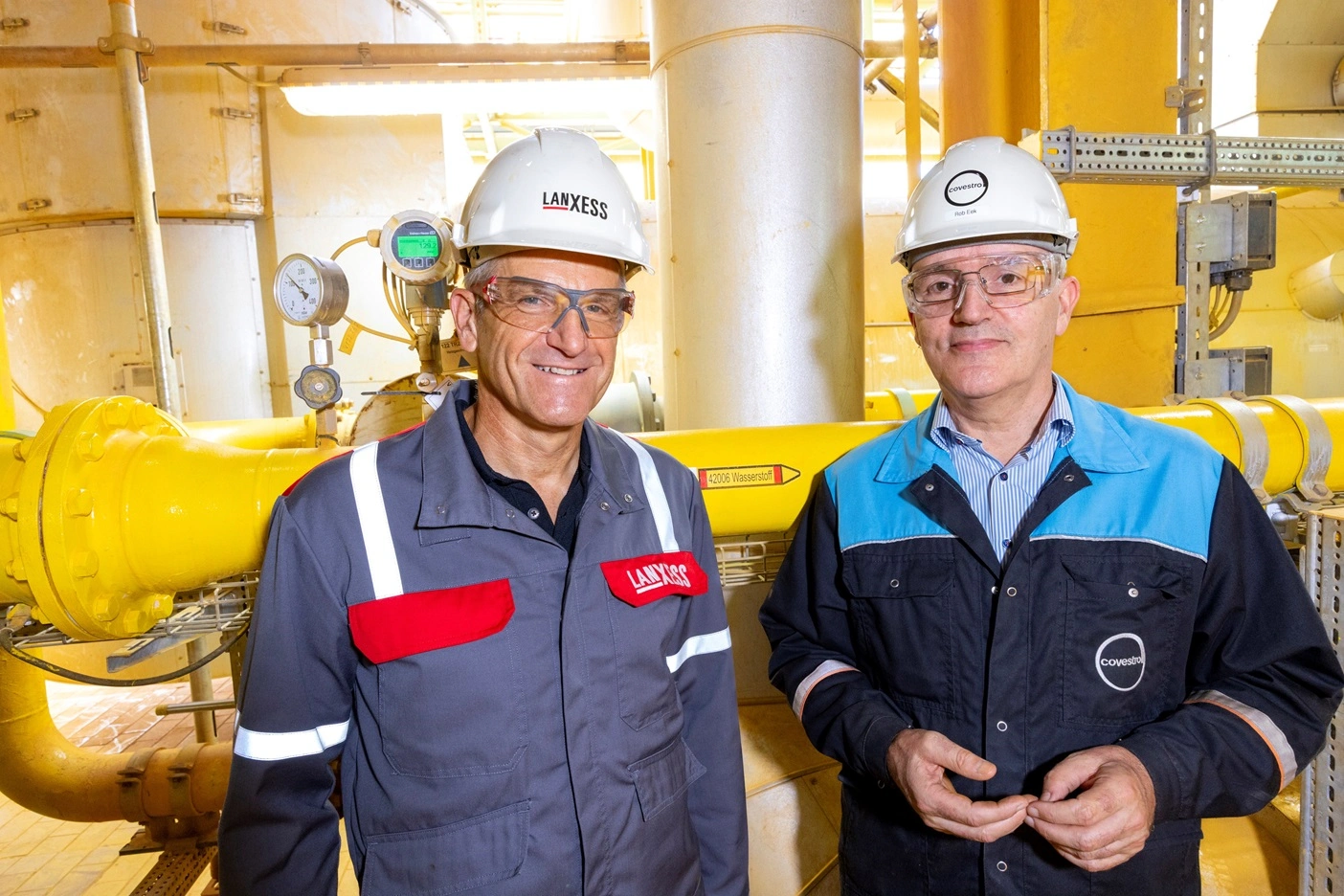
Michael Ertl, Head of Inorganic Pigments Business Unit at Lanxess:
Switching from a natural gas burner to a hydrogen burner is a significant technological step towards low-greenhouse-gas processes. We are proving that decarbonizing industry works not only in pilot projects, but also in the day-to-day operation of large production facilities.
Rob Eek, Production Manager at Covestro (Krefeld-Uerdingen):
The project shows that industrial partners at a Verbund site can particularly successfully shape the transition to climate-friendly production. Close integration, short pipeline routes, shared infrastructure, and established safety concepts ensure a reliable hydrogen supply.