








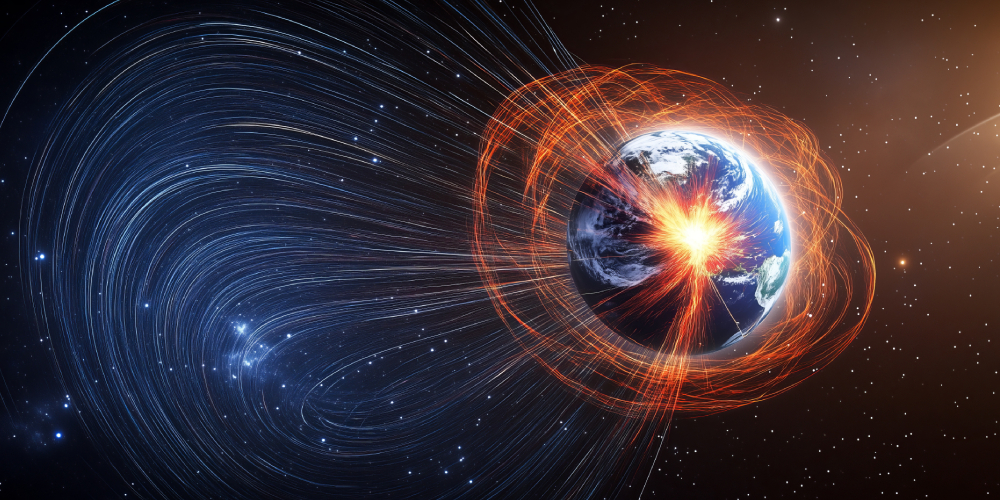
A new scientific study has revealed a key piece of the puzzle behind how Earth’s magnetic field is generated and maintained and the answer lies deep within the planet. Research published in Nature Geoscience shows that two massive, intensely hot rock formations at the base of Earth’s mantle play a decisive role in shaping and sustaining the magnetic field.
These continent-sized structures, referred to by researchers as “blobs,” are located beneath Africa and the Pacific Ocean, approximately 3,000 kilometers below Earth’s surface, near the boundary between the mantle and the core.
Heat contrast fuels the planet’s magnetic engine
According to the researchers, the blobs are significantly hotter than the surrounding lower mantle. This temperature contrast creates a strong heat flow between the mantle and the core, which is essential for maintaining the geodynamo, the process that drives the movement of molten iron and nickel in Earth’s outer core.
The geodynamo is responsible for generating Earth’s magnetic field, which acts as a protective shield against harmful solar radiation. Scientists note that without this sustained internal heat transfer, Earth could resemble Mars or Venus, planets that lack a strong, stable magnetic field.
Ancient magnetic records and simulations point to the same conclusion
The research team analyzed magnetic signatures preserved in rocks dating back hundreds of millions of years and combined these findings with advanced computer simulations to model how Earth’s magnetic field responds to different internal heat distributions. The most realistic results emerged in scenarios where the giant mantle blobs actively influenced heat transfer between the core and the mantle.
The findings also suggest that these deep structures may help keep certain regions of the magnetic field stable over hundreds of millions of years.
Origins remain uncertain
Despite the insights gained, scientists emphasize that many questions remain about the origin, composition, and evolution of these massive rock formations. However, they note that a deeper understanding of the blobs could provide critical clues about Earth’s internal dynamics and the long-term evolution of its magnetic field.