








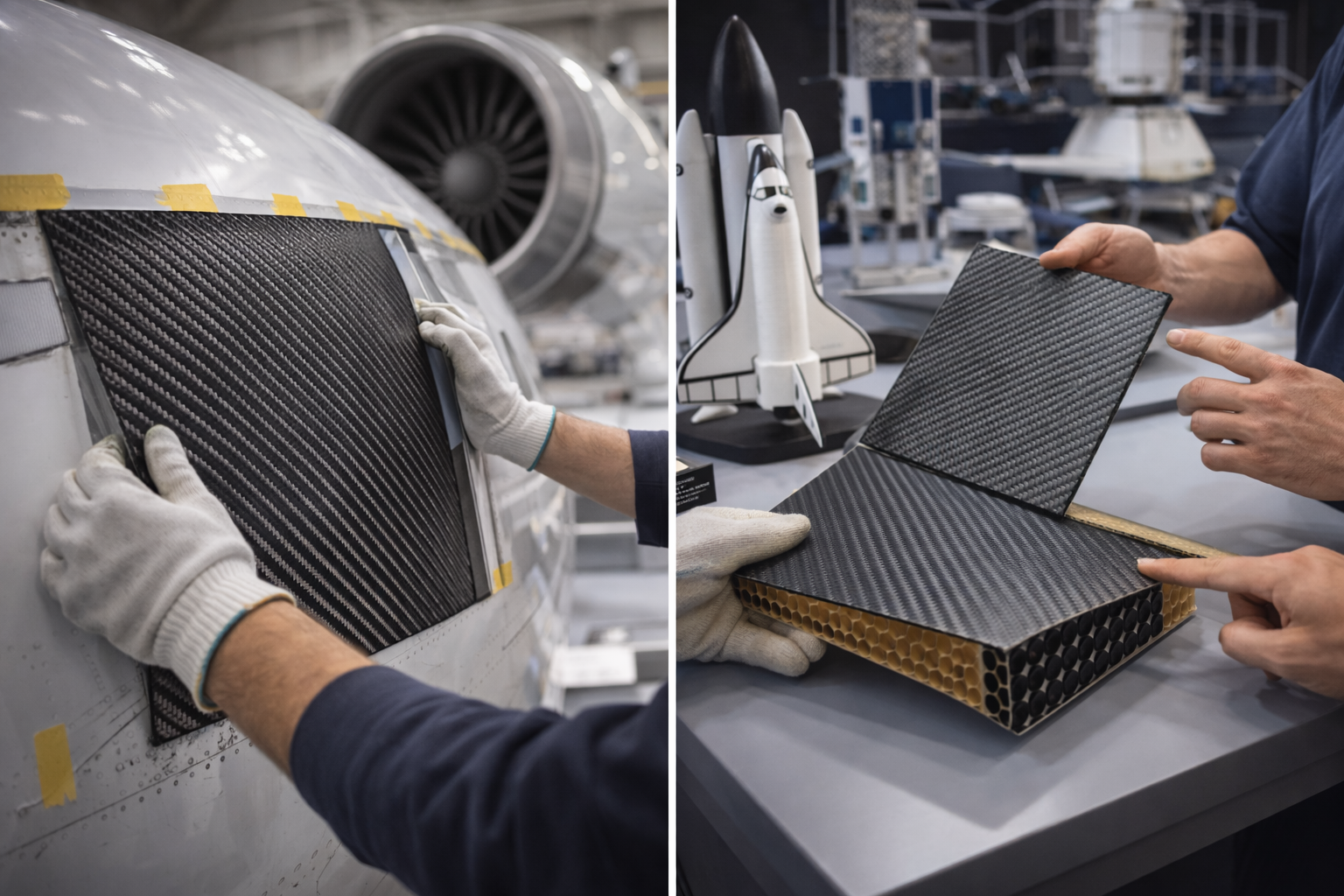
Composite materials have become a key choice across industries such as aerospace, construction, automotive, and energy because they combine light weight, high strength, and long service life in a single structure. While traditional materials often struggle to meet multiple performance demands at once, composites achieve this by intelligently combining different materials into one high-performing solution. In this article, we explain what composites are, how they are structured, the main composite material types, and the most important areas where they are used today.
What Is a Composite Material?
A composite material is an engineered material made by combining two or more different components in a way that allows them to complement each other’s weaknesses. The resulting structure can deliver improved performance beyond what each individual material could achieve on its own.
The main goal of composites is to use the right material in the right place. When a component needs to be both lightweight and capable of carrying high loads, composite solutions often become one of the most efficient options.
Key Components of Composite Materials
Most composite materials consist of two main phases: the matrix and the reinforcement.
What Is the Matrix (Base Phase)?
The matrix forms the main body of the composite. It holds the reinforcement together, protects it from external conditions, and transfers loads throughout the structure. Matrix materials are typically selected from the following categories:
- Polymer (resin-based) matrices
- Metal matrices
- Ceramic matrices
What Is the Reinforcement (Strengthening Phase)?
The reinforcement is the element that provides strength and stiffness to the composite. It is usually made of fibers or particles. Common reinforcement materials include:
- Glass fiber
- Carbon fiber
- Aramid (Kevlar)
- Ceramic fibers and particles
What Are the Advantages of Composite Materials?
The rapid expansion of composites across many industries is driven by their ability to improve performance while also supporting cost efficiency over the long term. The table below highlights the most significant advantages of composite materials.
| Advantage | What it provides | Where it stands out |
|---|---|---|
| Lightweight and high strength | Delivers high load capacity with reduced weight | Aerospace, automotive, sports equipment |
| Corrosion and chemical resistance | Resists rust and harsh chemical environments | Construction, infrastructure, marine, energy |
| Design and manufacturing flexibility | Enables complex shapes and integrated structures | Automotive, consumer products, defense |
| Long service life and low maintenance | Reduces repair needs and lifecycle costs | Bridge strengthening, façade systems, industrial equipment |
What Are the Main Types of Composite Materials?
Composite material types are most commonly classified according to the matrix material. Factors such as temperature, loading conditions, environmental exposure, and cost determine which composite system is most suitable.
Polymer Matrix Composites (PMC)
This is the most widely used composite category. Fibers such as glass or carbon are embedded in resin matrices like epoxy or polyester. Polymer matrix composites are popular due to their light weight, ease of production, and broad applicability.
Metal Matrix Composites (MMC)
In these systems, a metal matrix is reinforced with ceramic fibers or particles. They are preferred in applications requiring high temperature resistance and improved wear performance.
Ceramic Matrix Composites (CMC)
Ceramic matrices reinforced with fibers form composites capable of operating in extremely high-temperature environments. They play a critical role in advanced engineering and high-performance technology sectors.
Fiber Reinforced Composites (FRP)
FRP stands for fiber reinforced polymer or plastic. This category includes systems such as glass fiber reinforced composites (GFRP) and carbon fiber reinforced composites (CFRP). FRP materials are widely used from structural strengthening in construction to lightweight automotive applications.
Where Are Composite Materials Used?
Composite applications continue to expand due to the unique balance of strength, reduced weight, and environmental resistance they provide. The table below summarizes the most common industries and typical uses.
| Sector | Composite applications | Typical examples |
|---|---|---|
| Aerospace and space | Weight reduction and high performance | Aircraft fuselage, wings, satellite and rocket parts |
| Automotive | Energy efficiency and optimized components | Body panels, battery protection systems, interior parts |
| Construction and infrastructure | Strengthening, durability, corrosion resistance | FRP wrapping/laminates, FRP rebars, façade panels |
| Energy | High strength with low weight | Wind turbine blades, solar panel support components |
| Healthcare and medical | Lightweight structures and user comfort | Prosthetics, implant elements, medical device components |
| Sports and consumer products | Enhanced performance and reduced weight | Bicycle frames, tennis rackets, surf equipment |
The Future of Composite Materials and Sustainability
Composite technologies are no longer focused solely on performance. Innovation is increasingly driven by sustainability, recycling potential, and reduced environmental impact. Three key areas are shaping the future of composites.
Biocomposites
Natural fiber reinforced composites are designed to reduce environmental footprint. Their use is growing in areas such as automotive interior components.
Recyclable Composite Systems
Thermoplastic-based composites offer better recycling options compared to traditional thermoset systems. As a result, next-generation products are increasingly adopting thermoplastic composites.
Smart Composites
Smart composites integrate sensors or monitoring systems that allow structural health tracking. These materials represent a new stage of development in aerospace, defense, and infrastructure safety applications.
Why Composite Materials Matter
Composite materials are among the most strategic materials in modern industry because they combine light weight, strength, corrosion resistance, and design flexibility in a single solution. As composite material types and applications continue to grow, sustainable composite technologies are also shaping the future of manufacturing and engineering worldwide.