






The history of perfume is often told as the history of liquid scent in a bottle. Yet humanity’s first deep relationship with smell was formed not around glass vessels, but around fire and smoke. The earliest “fragrance technology” was not a distillation apparatus, but the aromatic cloud released by burning resin. To trace the true origins of perfume, we must therefore look not to modern notes and accords, but to incense, offering, and purification.
In the ancient Mediterranean and Near East, scent was not merely a matter of pleasantness; it was a means of communicating with the divine, sanctifying space, and preparing the body.
Behind this ritual practice lay an intuitive but powerful chemistry. Concepts we now describe as volatility, carriers, and persistence were already at work, long before perfume took the form of a bottled liquid.
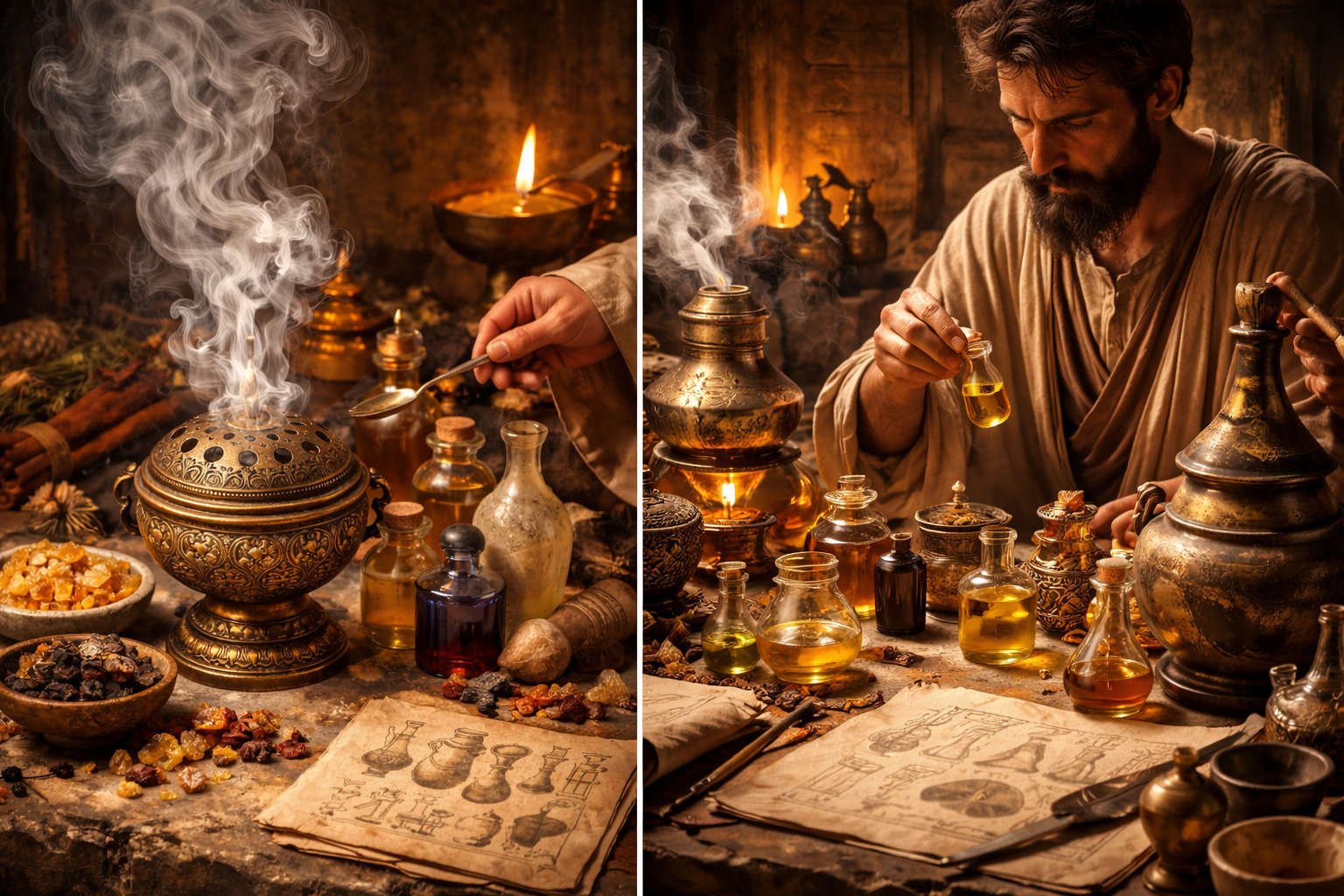
1) Scent First Entered the Air: The Cultural Logic of Incense
Heat was the first technology that carried volatile molecules into the air.
Across cultures, the act of burning incense serves remarkably similar purposes: masking unpleasant odors, “cleansing” the air, and making the invisible perceptible. The upward movement of smoke gives material form to presence, protection, and transcendence. Incense thus functioned not simply as a fragrance, but as a ritual medium.
At this stage, perfume’s earliest formula might be expressed as:
“A place + a moment + a scent” = the completion of a ritual.
Smell leaves a powerful imprint on memory. As smoke fills a space, it transforms not only the atmosphere but also the perceptual framework through which that space is experienced. Scent becomes a signal of transition: the place changes, time shifts, and the body enters a different state.
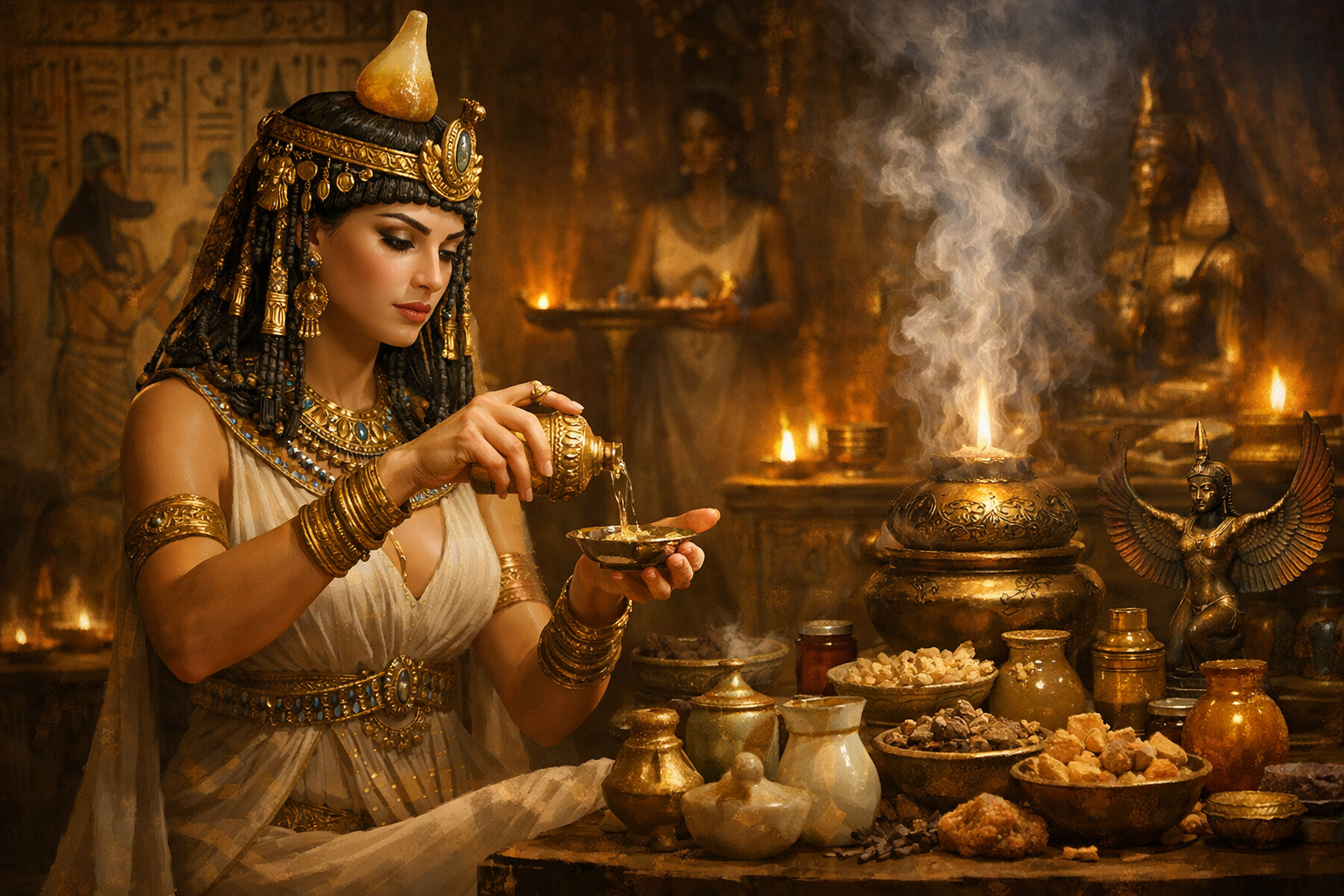
2) The First “Formula Notebooks”: Oils, Unguents, and Temple Workshops
What makes scent last is not only the plant, but the system that carries it.
In the ancient world, the most common carrier of scent was not alcohol, but oil and fatty ointments. In Egypt in particular, perfumed oils developed in close connection with religious practice, daily body care, and funerary rites. Aromatics such as frankincense, myrrh, cinnamon, and cassia were typically incorporated into oil-based preparations.
This reveals an essential point: from the very beginning, perfume derived its meaning not only from which botanical materials were used, but from which carrier, in what proportions, and over what duration they were processed. Ancient perfume workshops were spaces where plants, time, heat, and carriers were managed together, early laboratories of mixture and transformation.
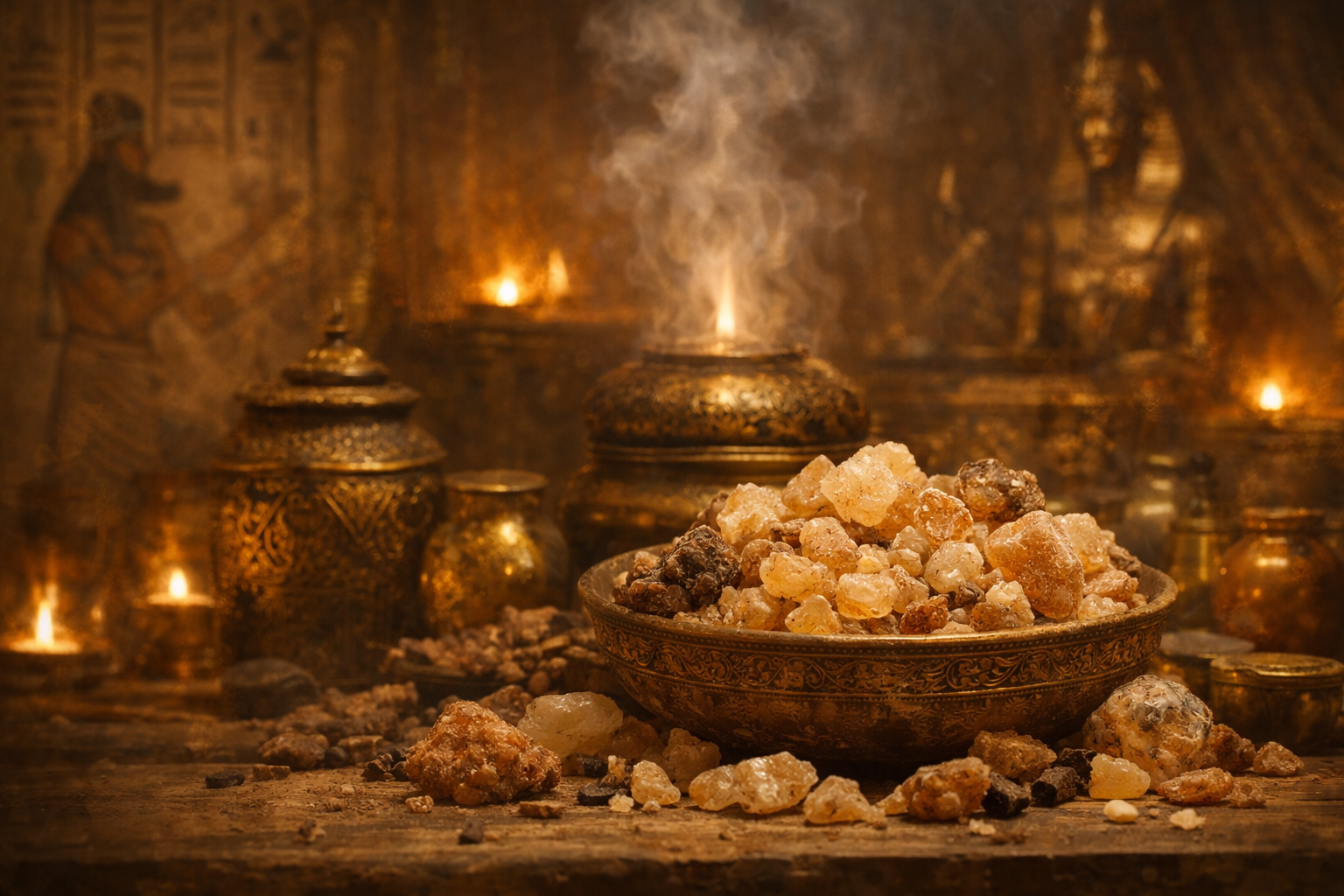
3) The Chemistry Connection: Why Resins Are So Effective
Resins naturally combine rapid diffusion with persistence.
Resins such as frankincense and myrrh can be considered the “supermaterials” of early perfume history because they perform two functions simultaneously:
-
They contain volatile compounds, allowing scent to disperse quickly.
-
They also include less volatile, resinous fractions, which help scent linger.
Botanical and economic-historical literature shows that these oleo-gum-resins owe much of their aroma to terpene derivatives, particularly sesquiterpenes. The aromatic profile released upon burning is therefore directly linked to chemical composition.
From a chemical perspective, incense burning is a mechanism for transferring scent molecules between phases. In its simplest form, it creates a three-phase system:
-
Solid phase: the resin (raw material)
-
Gas phase: volatile aromatic molecules
-
Aerosol/smoke: the medium dispersing scent into space
Combustion: Burning incense does more than “release fragrance.” Heat rapidly vaporizes volatile components while simultaneously producing smoke and aerosols that carry those molecules through the environment. This is why incense was one of the most effective forms of ambient scenting in antiquity.
Solubility: In oil-based ointments, chemistry operates through solubility. Many aromatic compounds dissolve more readily in lipids than in water, explaining why oil emerged so early as a preferred scent carrier.
Ernest Guenther’s classic reference The Essential Oils systematically describes methods such as maceration, extraction, and distillation, offering a modern chemical framework for understanding how plant aromatics are “captured.” It provides valuable background for interpreting ancient practices without projecting modern techniques backward.
Chemical Note
Antiquity had no term equivalent to “fixative,” yet oils and resins slowed the evaporation of volatile compounds and performed a similar function. Today, we describe this effect through concepts such as vapor pressure, phase distribution, and volatility balance.
4) Blends Like Kyphi: The Birth of Multi-Component Fragrance
From single material to designed composition.
In ancient Egypt, complex incense blends such as kyphi mark a decisive threshold in perfume history. Scent is no longer a single material, but a composition. These blends were even associated with specific times of day, suggesting an early sensitivity to how scent unfolds over time.
Kyphi does not resemble a modern note pyramid, yet it clearly relies on combining materials with differing volatility. Some components rise quickly, others persist in space, and still others stabilize the mixture. The result is a temporally structured olfactory experience.
A. Lucas’s work in the Journal of Egyptian Archaeology demonstrates that aromatic and ointment use in Egypt dates back to very early periods, and that oils and resins could serve both aromatic and stabilizing functions. The modern idea of a fixative thus finds a functional precursor here, long before the term itself existed.
Before the Bottle, There Was a System
In this earliest phase, perfume was not a liquid preserved in glass, but an event in space and a mixture on the body. Incense transformed air into a carrier, oil anchored scent to skin, and resins naturally balanced diffusion with persistence. Long before perfume became an aesthetic object, it was already a form of chemical behavior knowledge.
In antiquity, scent was understood through observation of its behavior rather than through molecular analysis. The next major transformation would require chemistry to step forward more explicitly, with distillation, new separation techniques and the deliberate isolation of aromatic substances.
References
-
Encyclopaedia Britannica, “Incense.”
-
Manniche, Lise. “Perfume.” UCLA Encyclopedia of Egyptology (2009).
-
Lucas, A. “Cosmetics, Perfumes and Incense in Ancient Egypt.” Journal of Egyptian Archaeology 16 (1930).
-
Guenther, Ernest. The Essential Oils (especially sections on history, production, and analysis).
-
Ethnobotany and economic botany literature on frankincense and myrrh (chemical composition and historical sources).
Writer/Editor: Öykü Nur YÜCE
Source
Araştırmacı Editör: Öykü Nur YÜCE