



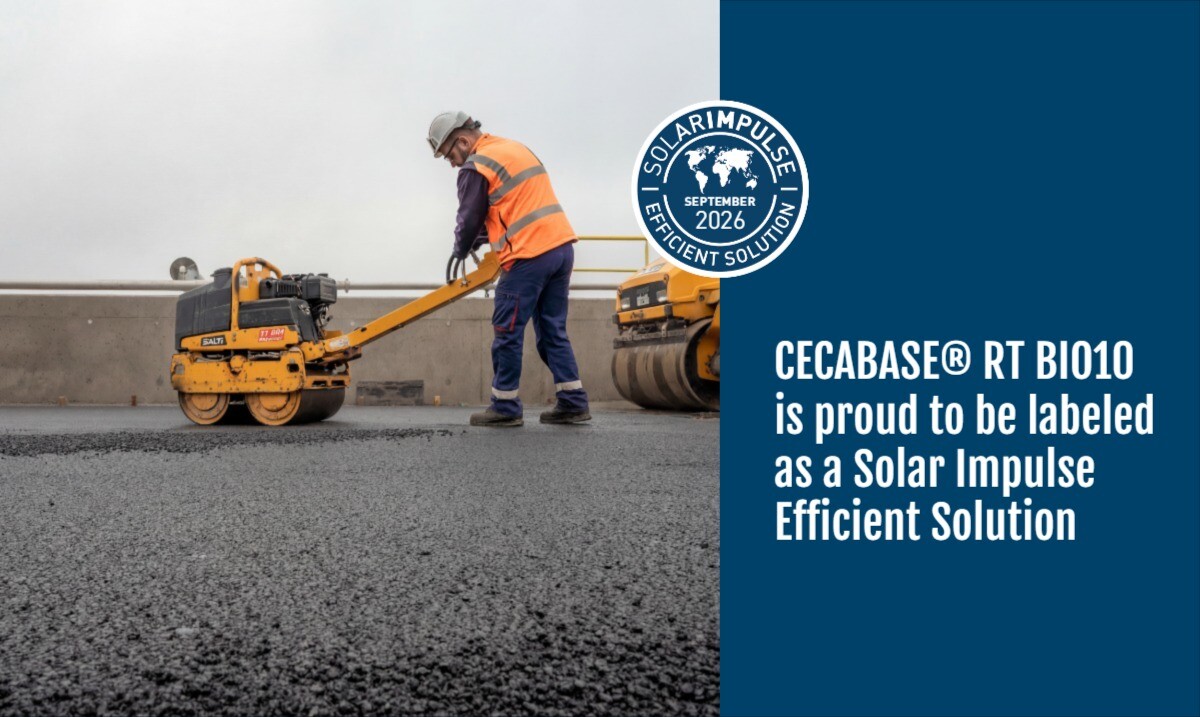
Certified with a 56% bio-based content under the NF EN 16785-2 standard, Cecabase® RT BIO 10 joins Arkema’s growing portfolio of Solar Impulse-labelled solutions alongside its Kynar Aquatec® PVDF range and bio-circular Rilsan® PA 11 and Pebax® Rnew® polymers.
200 ppm Dosage Cuts Production Temperatures by 40°C and Fuel Use by 15%
Technical documentation and environmental assessments published by the Solar Impulse Foundation quantify the operational gains achieved at asphalt production plants:
Thermal & Fuel Efficiency: Applied at approximately 200 ppm in conventional mixes, the additive lowers production and paving temperatures by up to 40°C—dropping baseline operating temperatures from roughly 170°C to 130°C. This thermal reduction cuts fuel consumption at asphalt plants by approximately 15%.
High RAP Utilization & Emissions Cuts: Supporting up to 50% reclaimed asphalt pavement (RAP) depending on mix design and operating conditions, mixes incorporating 40% RAP maintain road durability while reducing lifecycle greenhouse gas emissions by 10% to 25%.
Economic Modeling Confirms 14% Overall Cost Savings
In the Foundation’s economic simulation, a conventional asphalt mixture produced at 170°C with 20% reclaimed material was benchmarked against a warm-mix formulation produced at 130°C containing 40% reclaimed material. The results confirmed that the warm-mix formulation delivers approximately 14% lower overall costs.
By entering the Solar Impulse Foundation’s #1000solutions portfolio chaired by Bertrand Piccard, Cecabase® RT BIO 10 joins a global roster of commercially proven technologies engineered to align ecological performance with industrial profitability.