



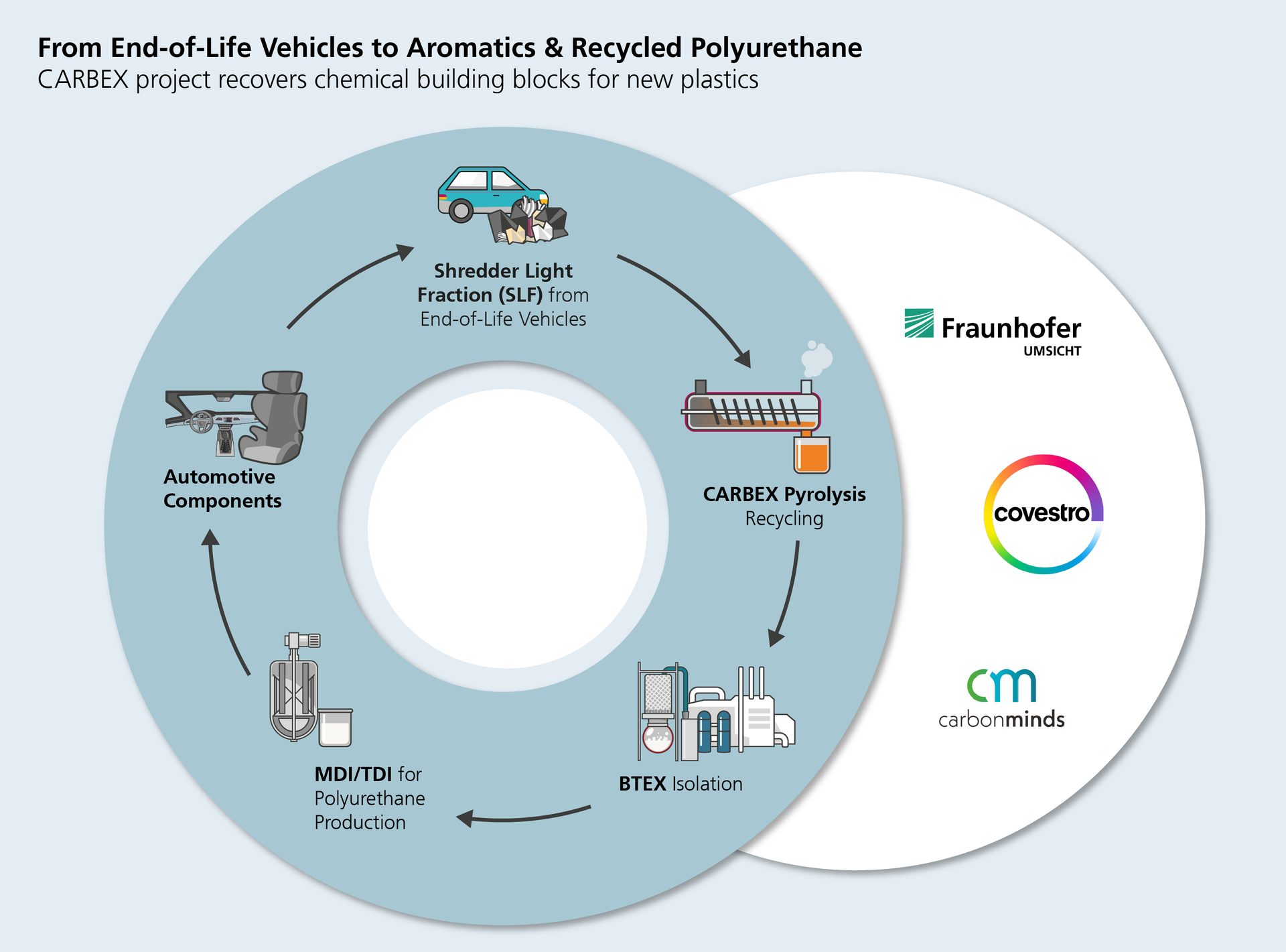
Funded by the German Federal Ministry of Research, Technology and Space under the KlimPro-Industrie II program (September 2026 to August 2029), CARBEX addresses a major carbon bottleneck in the automotive and chemical industries.
Covestro relies on benzene to manufacture MDI (methylene diphenyl diisocyanate) for rigid insulation foams and automotive structural parts, and toluene to produce TDI (toluene diisocyanate) for flexible foams in mattresses, furniture, and car seats. In Germany alone, more than 466,000 metric tons of ASR are generated annually—containing roughly 20% polyurethane by weight—with approximately 210,000 metric tons currently routed to incineration or disposal.
Dr. Stefanie Eiden (Project Manager, Covestro):
"With CARBEX, we are tapping into a source of carbon that is currently mostly burned. If we can recover benzene and toluene from automotive shredder residue at the quality required for our MDI and TDI production processes, we can close a material loop while replacing an emissions-intensive step in the production of basic chemicals."
Autocatalytic Reforming via Pyromat Technology
CARBEX utilizes Fraunhofer UMSICHT’s patented Pyromat process, which couples pyrolysis with autocatalytic reforming using the generated pyrolysis coke simultaneously as a catalyst and an adsorbent:
Contaminant Tolerance & Halogen Binding: At roughly 500°C, coke constituents—including calcium carbonate, titanium dioxide, and copper—catalyze aromatic formation while binding halogens such as chlorine and bromine. This prevents halogens from contaminating the pyrolysis oil and eliminates the need for expensive external catalysts prone to deactivation in real-world waste streams.
Emissions Reduction: Laboratory trials yielded pyrolysis oil containing 62% BTEX by weight (roughly 60% higher than conventional pyrolysis oils) while cutting halogen levels by up to 99%. Process emissions stand at approximately 1.1 metric tons of $CO_2e$ per metric ton of BTEX—nearly 40% lower than conventional fossil naphtha steam cracking (1.6 to 1.8 metric tons of $CO_2e$).
Dr. Thomas Fehn (Project Manager, Fraunhofer UMSICHT Sulzbach-Rosenberg):
"The Pyromat technology uses pyrolysis coke as both a catalyst and an adsorbent. This makes the process robust and cost-effective, especially when dealing with highly contaminated waste streams. As part of the project, we are taking this approach from the laboratory to continuous pilot-scale operation at a throughput of 10 kilograms per hour."
Market studies indicate that industrial-scale deployment across Germany could abate up to 640,000 metric tons of $CO_2e$ annually by displacing fossil-based naphtha.
Scaling Toward 2032 EU Recycling Mandates
Within the project scope, Fraunhofer UMSICHT is converting a fixed-bed reactor into a moving-bed system to produce at least 50 kilograms of BTEX-rich pyrolysis oil with halogen concentrations below 30 ppm—the purity threshold for industrial chemical crackers. Covestro is developing a model-based distillation process to isolate benzene and toluene for MDI/TDI validation and techno-economic evaluation, while Carbon Minds GmbH conducts an ISO-compliant cradle-to-gate life cycle assessment (LCA).
With German aromatics production exceeding 2.6 million metric tons annually (valued at €1.95 billion), CARBEX also positions value chain partners ahead of the upcoming EU End-of-Life Vehicles Regulation (ELVR), which mandates closed-loop recycled plastic content in new vehicles starting in 2032.
About Covestro
Covestro is one of the world’s leading manufacturers of high-quality polymer materials and their components, serving key sectors including mobility, building and living, electrical and electronics, healthcare, and sports. Fully aligned with the circular economy, Covestro aims to achieve climate neutrality for Scope 1 and Scope 2 emissions by 2035, and for Scope 3 emissions by 2050. In fiscal year 2025, the company generated sales of €12.9 billion, operating 46 production sites worldwide with approximately 17,600 full-time equivalent employees.