






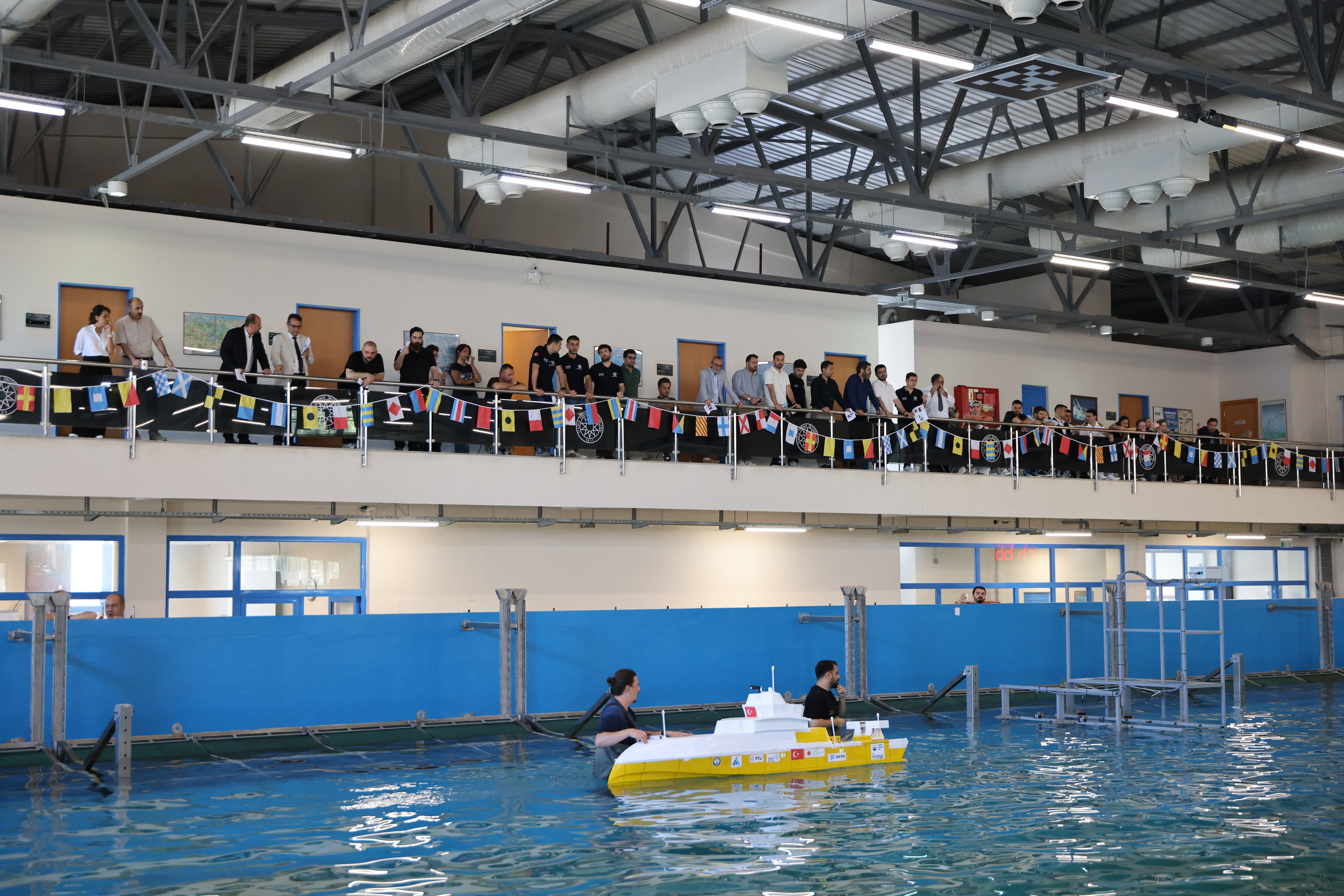
At a time when verified local design authentication layouts and autonomous marine testing nodes dictate performance criteria inside the defense and shipbuilding industries, Yıldız Technical University (YTU) has scaled its institutional R&D footprint. Managed under the dual stewardship of the Faculty of Naval Architecture and Maritime and the YTU MARINE Research Center, the newly commissioned Hydrodynamics Laboratory was introduced via a high-level defense and industrial convention at the Davutpaşa Campus.
Backed by capital allocations from the Presidency Strategy and Budget Directorate since 2019, the facility is engineered to process an expansive R&D grid extending from the resistance, propulsion, and maneuvering profiles of model ships in calm/wavy regimes to the hydrodynamic tracking of offshore wind turbines. The master infrastructure plan projects the node’s eventual evolution into a multi-disciplinary "Advanced Hydrodynamics Center of Excellence," integrating coastal and harbor engineering modules.
A First for Turkey: Controlled "Free Running" Simulation Matrices
The launch sequences showcased a domestic academic milestone by deploying "free-running" experimental setups specifically calibrated for autonomous surface and sub-surface platforms:
Calm Water Routines: Initial test tracks cataloged the baseline path-following tolerances, turning diameters, and structural steering behaviors of autonomous models.
Synthesized Wave Environments: Activating the facility's heavy-duty wave-maker arrays, engineers generated precise hydrodynamic perturbations to cross-examine how autonomous guidance systems hold course and maintain equilibrium against multi-axis fluid loads.
Methodological Upgrade: Departing from traditional captive model setups where hulls are physically restricted to measure pure force vectors, this facility enables unconstrained, telemetry-driven free-motion testing matching authentic oceanic behaviors.
Industrial-Academic Integration and Diplomatic Attendance
The corporate presentation drew key delegations from the Presidency of Defense Industries (SSB), the Turkish Navy Design Project Office (DKK), TÜBİTAK MAM, ASELSAN, ASFAT, MKE EGEM, STM, Türk Loydu, and Sefine Shipyard. Contextualizing the commercial returns of academic technology transfers, YTU Rector Prof. Dr. Eyüp Debik and Dean of the Faculty of Naval Architecture and Maritime Prof. Dr. Serkan Ekinci remarked:
Prof. Dr. Eyüp Debik (YTU Rector): "Robust research infrastructures hold paramount strategic value for maritime affairs, defense technologies, and university-industry integration. This Hydrodynamics Laboratory is structurally equipped to serve not just our university, but Turkey's defense ecosystem, shipbuilders, state entities, and the broader scientific community. Merging academic knowledge synthesis with industrial execution tracks directly augments our national capacity to pioneer critical dual-use technologies."
Prof. Dr. Serkan Ekinci (Dean): "A competitive maritime sector relies heavily on advanced research hubs, qualified human capital, and forward-looking engineering workflows. This facility, armed with sophisticated wave-generation systems, fills a critical operational void within our domestic university landscape. It will deliver essential scientific baselines for next-generation naval platforms, autonomous surface vessels, and offshore renewable energy grids."