







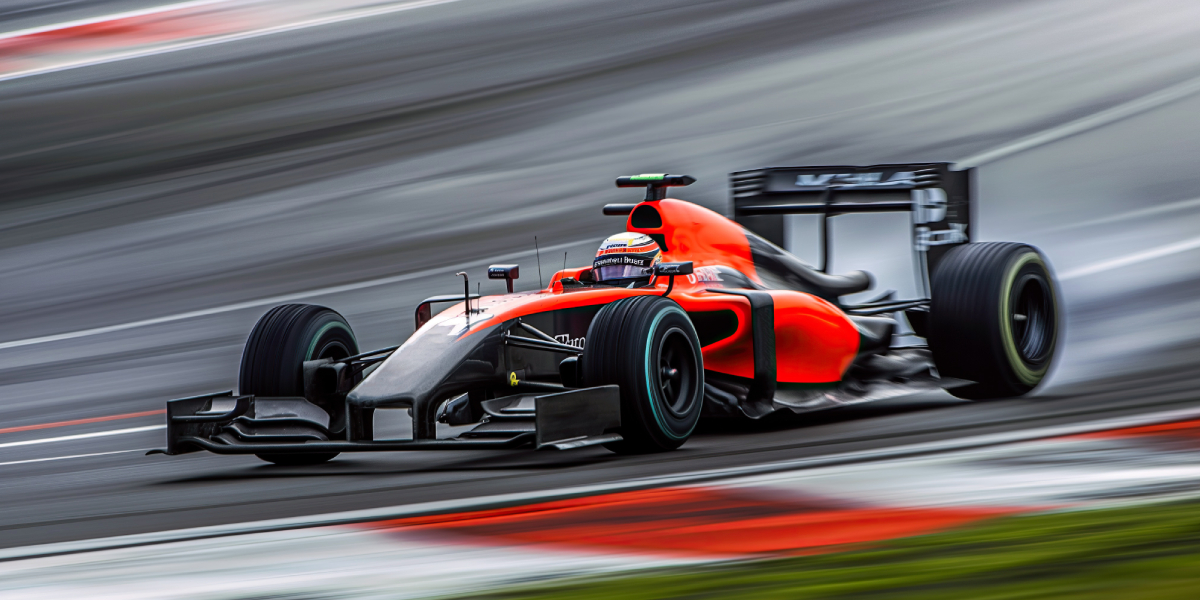
In Formula 1, the fate of a race is often hidden not in the engine, but in the chemical formula of the four tires, the only point of contact between the car and the ground. The difference between "soft," "medium," and "hard" compounds isn't just a colored stripe; it is a relentless struggle of thousands of polymer chains reacting to temperature.
1. Beyond Rubber: Complex Polymer Blends
An F1 tire contains much more than just natural rubber. Engineers blend synthetic polymers like Styrene-Butadiene Rubber (SBR) with carbon black, silica, and specialized resins.
-
The Silica Revolution: In modern F1 chemistry, silica plays a critical role in increasing grip on wet surfaces and reducing rolling resistance.
2. Glass Transition Temperature (Tg) and the Working Window
The most critical term in tire chemistry is the Glass Transition Temperature (Tg). This is the point where a polymer transitions from a hard, brittle state to a flexible, sticky (elastomeric) state.
-
Soft Compound: Has a lower Tg value; it becomes "sticky" quickly even at lower temperatures but wears out faster as its molecular bonds break more easily.
-
Hard Compound: Has a higher Tg value. The tire needs to exceed 100°C to reach maximum grip, but the polymer chains are much more resistant to heat.
3. Vulcanization and Molecular Cross-Links
The process that determines a tire's durability is vulcanization. Sulfur atoms create "bridges" between polymer chains. When a tire begins to "grain" during a race, it actually means these cross-links are snapping under extreme mechanical stress. Chemists adjust the density of these bonds to determine the "life" of the tire.
4. Chemical Grip: Van der Waals Forces
A tire doesn't just grip the road physically; it "bonds" chemically. Once the tire reaches its operating temperature, Van der Waals forces are formed between the rubber molecules and the microscopic irregularities of the asphalt. When drivers say they need to "warm up the tires," they are providing the energy required to trigger this chemical interaction.
The Seconds Won by Chemistry
A pit-stop strategy in F1 is essentially a calculation of degradation kinetics. Engineers manage that delicate balance between the chemical life of the tire and the lap time. A driver's fastest lap depends on the perfect bond created between the asphalt and the polymer chains designed by chemists. As chemistry evolves, tires will continue to be lighter, faster, and more durable, remaining the hidden architects of the podium.