






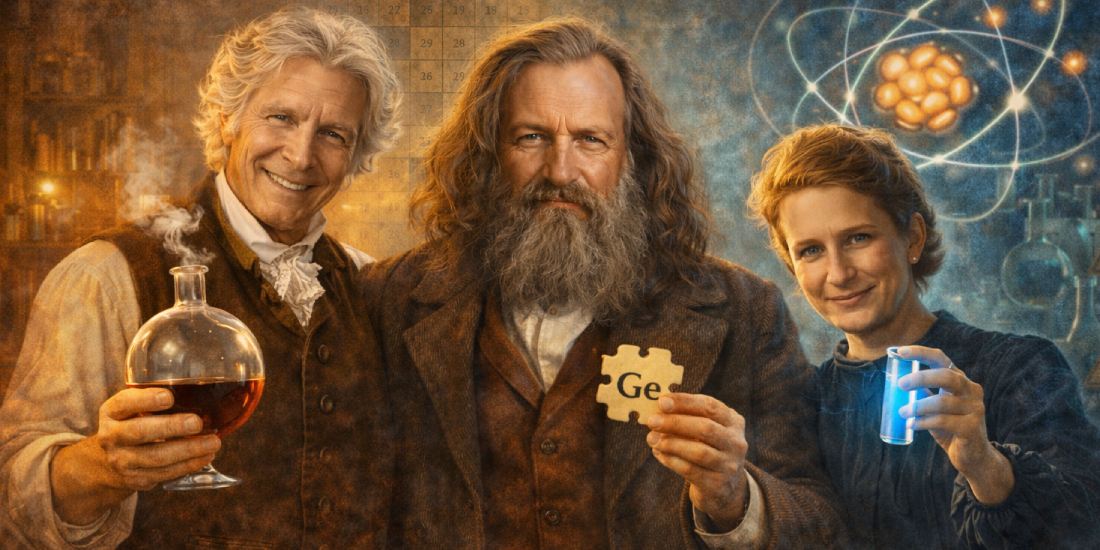
The world of chemistry is often remembered through static formulas and the unchanging squares of the periodic table. However, the discovery of each element is, in fact, an epic adventure filled with great risks, intense rivalries, and an insatiable curiosity. Produced by PBS, "The Mystery of Matter: Search for the Elements" takes this adventure from the dusty shelves of the laboratory and brings it to our screens.
More Than a Documentary: A Time Machine
What sets this series apart from ordinary science documentaries is its ability to transport the audience back to that moment of uncertainty—where "knowledge" did not yet exist. Guided by the captivating narration of Michael Emerson, we suddenly find ourselves in the stuffy laboratories of the 18th century, hunting for mysterious gases.
Three Key Pillars of the Narrative:
1. The Growing Pains of Transition from Alchemy to Chemistry: The first episode focuses on the famous rivalry between Joseph Priestley and Antoine Lavoisier as they struggled to discover that "air" was not a single substance. We witness the laying of the foundations of modern chemistry and how the use of the balance (quantitative chemistry) transformed the field from a form of "magic" into a true scientific discipline.
2. Bringing Order to Chaos: Mendeleev’s Dream: Did you know the mental anguish behind the Periodic Table we all know by heart? The documentary likens Dmitri Mendeleev’s struggle to organize the elements to a giant jigsaw puzzle. His courage to predict gaps beyond the known elements—and his foresight into their properties—is portrayed as one of the most compelling scenes in the series.
3. Journey to the Heart of the Atom: The final episodes focus on the revolutionary era where chemistry joined forces with physics, highlighting the lives of Marie Curie and Glenn Seaborg. The synthesis of artificial elements and the discovery of the atom's internal world are presented not just as a scientific chronology, but as a legacy of human achievement.
Technical Fidelity: Replicas and Experiments
The documentary crew meticulously recreated all laboratory apparatus—from Joseph Priestley’s lenses to Lavoisier’s massive gasometers—staying true to the originals. This is more than just a visual feast; it is a technical documentation that allows us to understand what an "impossible task" it was to measure the mass of a gas 250 years ago.
Did You Know?
-
A Radioactive Legacy: The laboratory notebooks used by Marie Curie over 100 years ago are still so radioactive that anyone wishing to examine them today must wear protective lead clothing.
-
Deadly Curiosity: Sir Humphry Davy tested the gases he discovered by personally tasting and inhaling them. While this boldness led to the discovery of many new elements, it ultimately cost him his health.
Closing Thoughts
If you look at the periodic table today and see only letters and numbers, this documentary will bring that table to life. When you witness the sweat, the rivalry, and sometimes the tragedy behind each element, your perspective on the laboratory will change. This production is an essential resource—not just for chemistry students, but for every professional who wishes to understand science as a "quest for truth" for humanity.