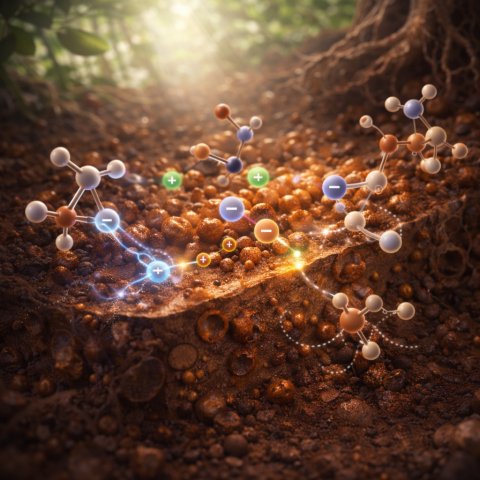








Molecular Electronics Meets Neuromorphic Computing
For decades, scientists have explored the idea of building electronics from molecules rather than silicon. The concept is elegant, but real molecular devices rarely behave like clean textbook systems. Inside working components, molecules form crowded, interactive networks where electrons and ions move, interfaces evolve, and tiny structural differences can produce strongly nonlinear responses.
At the same time, neuromorphic computing has pursued materials that do more than mimic the brain. The long-term goal is hardware where memory, computation, and adaptation happen within the same physical substance, in real time. Many current approaches, often based on oxides and filamentary switching, still rely on carefully engineered learning-like behaviors rather than materials that naturally encode learning.
A new study from the Indian Institute of Science (IISc) suggests these two challenges may converge through chemistry.
A Single Device That Can Become Memory, Logic, or a Synapse
Led by Sreetosh Goswami at IISc’s Centre for Nano Science and Engineering (CeNSE), the research team created molecular devices that can be tuned to perform multiple electronic roles. Depending on how the device is stimulated, it can act as a memory unit, logic gate, selector, analog processor, or electronic synapse.
“It is rare to see adaptability at this level in electronic materials,” says Goswami. “Here, chemical design meets computation, not as an analogy, but as a working principle.”
This multifunctionality is especially promising for neuromorphic systems, where devices must respond dynamically rather than follow rigid, predefined switching.
Ruthenium Complexes Drive “Shape-Shifting” Electronic Behavior
The flexibility comes from the molecular chemistry behind the platform. The team synthesized 17 ruthenium complexes and examined how small differences in molecular geometry and ionic environment influence electronic transport.
By adjusting ligands and surrounding ions, a single device could shift between digital and analog behavior, spanning a wide range of conductance values. This means the same molecular film can behave like multiple components depending on conditions, rather than requiring separate materials for each function.
“What surprised me was how much versatility was hidden in the same system,” says Pallavi Gaur, the first author and a PhD student at CeNSE. “With the right molecular chemistry and environment, a single device can store information, compute with it, or even learn and unlearn. That’s not something you expect from solid-state electronics.”
The molecular synthesis was carried out by Pradip Ghosh, with device fabrication led by Gaur.
A Theory That Predicts Function From Molecular Structure
One reason molecular electronics has struggled historically is the lack of a predictive framework linking molecular structure to device behavior. In this study, the team addressed that gap by developing a transport model grounded in many-body physics and quantum chemistry.
Using this approach, the researchers traced how:
-
Electrons move through molecular films,
-
Molecules undergo oxidation and reduction events,
-
Counterions shift positions inside the molecular matrix.
Together, these coupled processes determine switching, relaxation behavior, and the stability of each molecular state.
Toward Neuromorphic Hardware That Learns in the Material
The key implication is that these ruthenium complexes offer a route toward materials where memory and computation are physically integrated, which is central to next-generation neuromorphic hardware.
The IISc team is now working on integrating these materials onto silicon chips to explore future AI hardware that is energy-efficient and intrinsically adaptive.
“This work shows that chemistry can be an architect of computation, not just its supplier,” says Sreebrata Goswami, a visiting scientist at CeNSE and co-author who led the chemical design.
Source: scitechdaily.com
Reference: “Molecularly Engineered Memristors for Reconfigurable Neuromorphic Functionalities” by Pallavi Gaur, Bidyabhusan Kundu, Pradip Ghosh, Shayon Bhattacharya, Lohit T, Harivignesh S, Santi P. Rath, Damien Thompson, Sreebrata Goswami and Sreetosh Goswami, 9 December 2025, Advanced Materials.
DOI: 10.1002/adma.202509143