





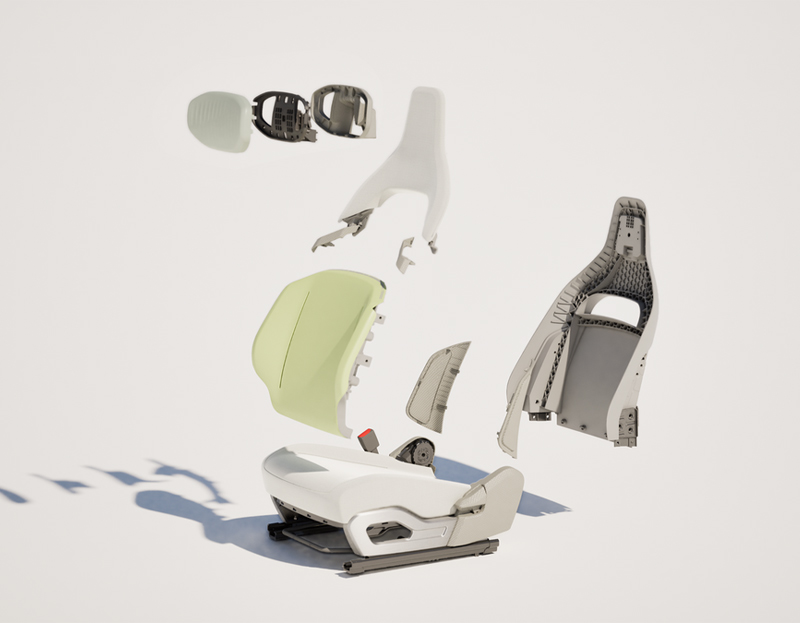
Uniting vehicle development, industrial design, and advanced materials engineering, the project translates end-of-life recyclability goals into an integrated seat architecture developed by Alten Korea alongside Hyundai-Kia and BASF. The design balances structural integrity, assembly efficiency, and ease of component separation within a single system.
Jongkook Lee (Vice President, Hyundai Motor Group):
"Study Car 2.0 gives us a practical environment in which to examine end-of-life considerations during vehicle and component development, rather than after the design has been completed. This seat project helps us assess how material selection, assembly methods and future dismantling requirements interact within a complex interior system."
Gwanghyun Kim (Executive Director, Alten Korea):
"A seat is a tightly integrated system, so changing how its components are separated also affects its structure, assembly and appearance. We therefore approached the seat as a complete system, balancing structural, assembly and separation requirements within one integrated design."
Circular Material Solutions Across the Seat Architecture
The concept seat integrates BASF materials featuring recycled and bio-circular feedstocks across cushioning, upholstery, and structural components:
Headrest (Elastollan® TPU): Partially derived from bio-based feedstock and processed using Whistling® supercritical foaming technology patented by Korea's Comtech Chemical.
Seat Cushion & Backrest (Elastoflex® W): Flexible polyurethane foam formulated with post-consumer recycled content.
Upholstery (Haptex®): Polyurethane synthetic leather manufactured with bio-circular feedstock.
Seat Back Cover & Frame (Ultramid® CR RC4): Polyamide (PA) containing post-consumer recycled waste applied to the rear cover, with the potential to replace the metal backrest frame for a unified, monomaterial-friendly structure.
Executive Perspective and Ongoing Partnership
Andy Postlethwaite (Senior Vice President, BASF Performance Materials Asia Pacific):
"Automotive seats require different material classes to work together within a single system. This co-creation allows us to examine the interfaces among PA, PU and TPU materials, including how material decisions relate to component construction and separation at the vehicle’s end of life."
Built on the Kia EV3 platform, Study Car 2.0 advances a long-standing concept vehicle collaboration between Hyundai Motor Group and BASF that previously delivered the Hyundai i-flow (2010), Hyundai RN30 (2016), and Kia EV3 Study Car (2024).