








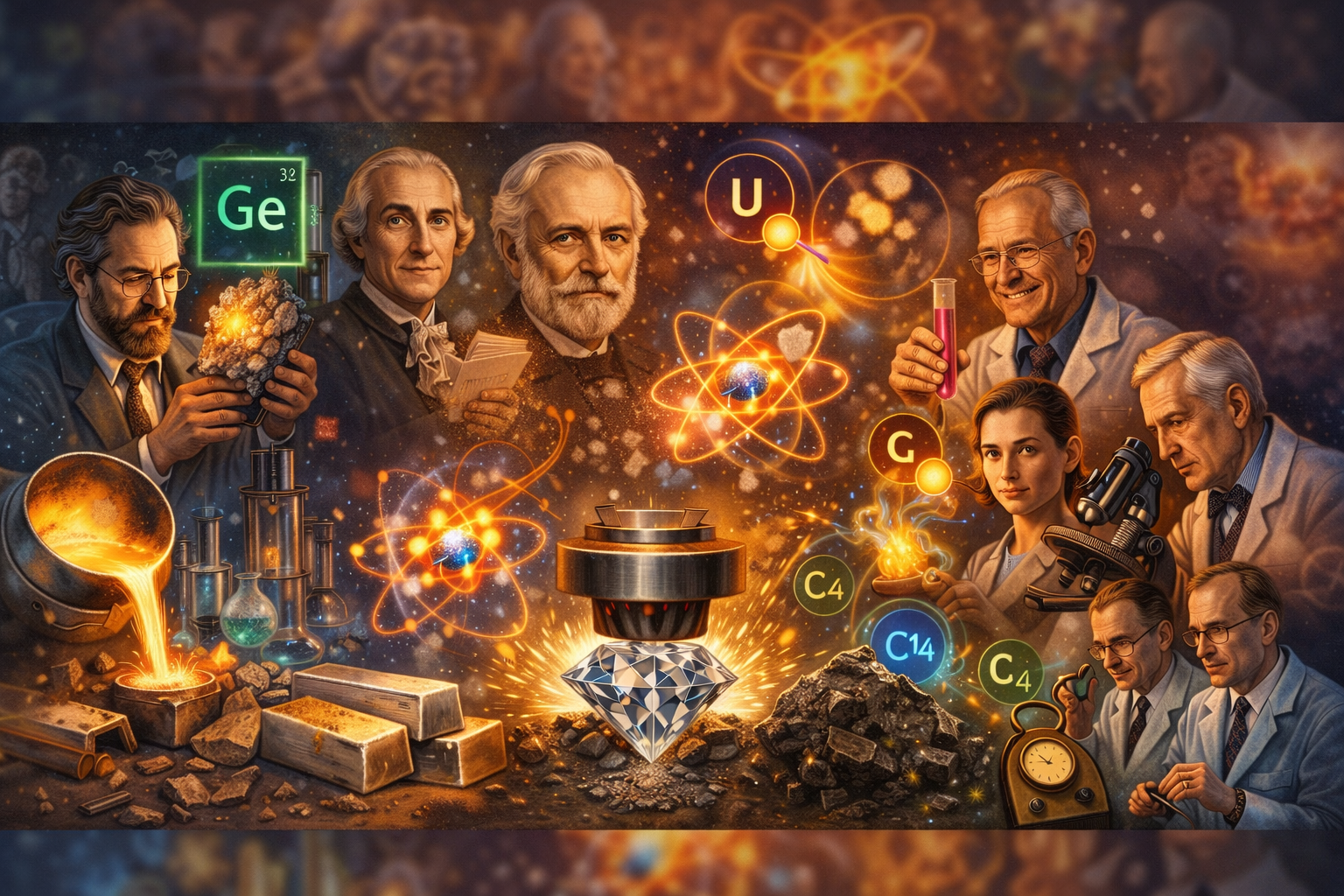
Chemistry is not just a science confined to test tubes; it is an art of "transformation" that makes the impossible possible. This week, we witness the birth of some of the greatest minds in human history and the critical moments that unlocked the secrets of nature. From a chemist who forgot to wash his hands and sweetened the world, to the evolution of coal into diamonds under immense pressure...
Here are the chronological milestones that changed the fate of matter throughout February:
1. February 6, 1886: The Discovery of Germanium
German chemist Clemens Winkler, while analyzing a mineral called "Argyrodite," discovered Germanium (Ge), filling a major gap in the periodic table. This discovery was one of the greatest triumphs proving the accuracy of Mendeleev’s periodic predictions.
2. February 8, 1794: Farewell to the Father of Modern Chemistry
Though a tragic date, it is critical for the chronology of science. Antoine Lavoisier, who established the Law of Conservation of Mass and transformed chemistry into a modern science, completed his final scientific notes during this period before his execution during the French Revolution. His principle, "Nothing is created, nothing is lost, everything is transformed," remains the heart of chemistry.
3. February 10, 1846: The Birth of the Pioneer of Sweeteners
The Birth of Ira Remsen: As mentioned before, Remsen, who discovered Saccharin as a result of a laboratory accident, was born. Beyond just a sweetener, he conducted thousands of studies to understand the molecular structure of organic chemistry and modernized chemical education.
4. February 11, 1939: The Nucleus Splits (The Announcement of Fission)
Lise Meitner and Otto Frisch published their groundbreaking paper in Nature, explaining that the splitting of the uranium nucleus releases massive amounts of energy and creates new elements (such as Barium). This marks the official starting line of the radiochemistry and nuclear age.
5. February 15, 1955: From Coal to Diamonds
Announcement of the First Synthetic Diamond: General Electric announced on this date that they had successfully produced diamonds in a lab for the first time by altering the crystalline structure of carbon under extreme pressure and temperature. It remains one of the most magnificent achievements in materials chemistry.
6. February 23, 1886: The Liberation of Aluminum
Charles Martin Hall, using a setup in his backyard shed, succeeded in obtaining pure aluminum from aluminum oxide through electrolysis. This invention turned aluminum from a metal more expensive than gold into an essential part of our daily lives.
7. February 27, 1940: The Discovery of Carbon-14
Martin Kamen and Sam Ruben discovered the Carbon-14 isotope, which forms the basis of radiocarbon dating. Thanks to this discovery, we can now determine the age of ancient fossils and archaeological artifacts through chemical analysis.