






1775 (January 4) — Benjamin Rush’s Public Chemistry Lectures
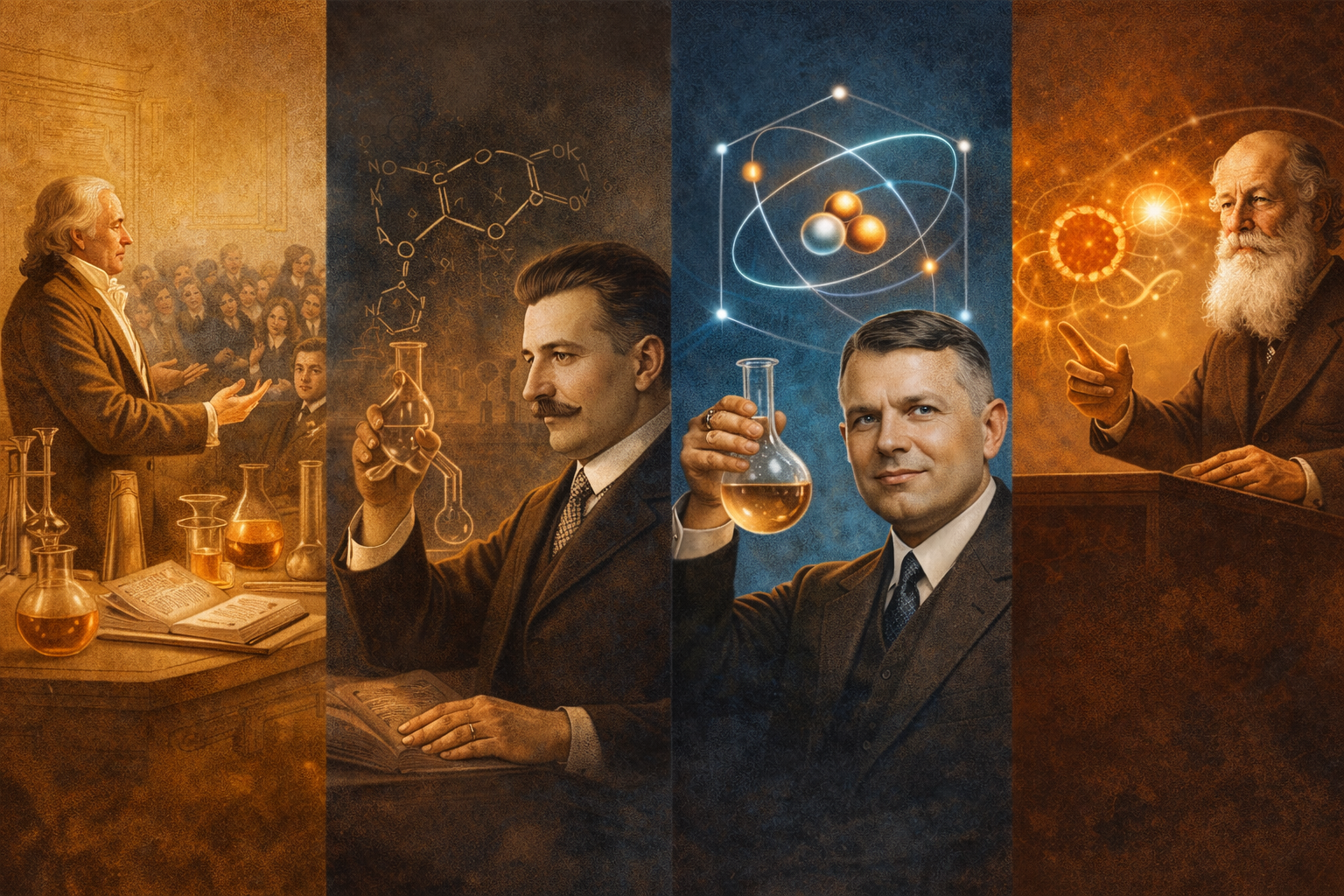
An important milestone was reached in America when chemistry began to move beyond the laboratory and become a public scientific discipline. Benjamin Rush contributed to spreading scientific knowledge to wider audiences by organizing chemistry lectures for the public in Philadelphia.
1865 (January 27) — Kekulé Reveals the Ring Structure of Benzene
For a long time, the structure of benzene — one of the cornerstones of organic chemistry — remained unsolved. In January 1865, Kekulé proposed the ring-shaped structural model, which made it possible to understand aromatic compounds and greatly accelerated the development of modern organic chemistry.
1891 (January 4) — Dow’s Bromine Production Revolution
Herbert H. Dow’s successful extraction of bromine from salty water through electrolysis was a critical breakthrough that reduced costs and scaled up production in the chemical industry. This method made a major contribution to the growth of industrial halogen chemistry.
January 1932 — The Discovery of Deuterium (Heavy Hydrogen) Is Announced to the Scientific World
As scientists worked to understand the internal structure of atoms, it became clear that hydrogen was not limited to a single form. Nobel Prize–winning chemist Harold C. Urey discovered deuterium, the heavy isotope of hydrogen, and this breakthrough was officially introduced to the scientific community in January 1932.
This discovery gave rise to isotope chemistry, opening new paths in nuclear chemistry, biochemistry, and spectroscopy. Today, deuterium forms the basis of many applications, from heavy-water reactors to biological labeling.
1939 (January 26) — Niels Bohr Announces Nuclear Fission to the World
In January 1939, Bohr’s conference in the United States brought the discovery of nuclear fission, the splitting of the uranium nucleus, to the international scientific community. This event launched a new era in nuclear chemistry and isotope research.
1942 (January 10) — Chemical & Engineering News (C&EN) Begins Publication
One of the most prestigious publications in the chemistry world, Chemical & Engineering News (C&EN), was first released under this name on January 10, 1942. The magazine became one of the strongest bridges of knowledge between scientists and industry.
1966 (January 24) — The Spectrum of an Einsteinium Compound Is Measured for the First Time
Superheavy elements such as Einsteinium (element 99) are extremely short-lived. A study conducted in Berkeley on January 24, 1966 reported the absorption spectrum of an einsteinium compound for the first time, marking a major achievement in actinide chemistry.
Source
Araştırmacı Editör: Öykü Nur YÜCE