







In the ancient world, scent was anchored to the body through oils; in the Islamic world, it was distilled and transformed into a more refined field of knowledge. In medieval Europe, however, the direction and meaning of scent shifted once again. Rather than following an aesthetic or technical trajectory, scent was redefined through its relationship with the body, morality, and disease.
In this context, scent was no longer merely a sensory experience, but an element that had to be controlled, limited, and used within specific conditions.

Scent and Morality: The Regulation of Bodily Practices
In medieval European thought, the body was not only a physical entity but also a site of moral evaluation. Within this framework, excessive attention to the body, adornment, and the use of fragrance were often associated with worldly indulgence and a lack of moderation. The regulation and restraint of the body were therefore linked not only to health, but also directly to moral order.
However, scent was not entirely rejected as a practice. Incense, particularly in religious rituals, continued to exist as an element associated with the sacred; in this context, scent functioned not as a worldly pleasure, but as a medium directed toward the divine. In contrast, personal use of fragrance did not carry the same level of legitimacy and was often approached with caution.
This distinction directly shaped the meaning of scent: while it was elevated within ritual contexts, it became a practice to be limited in everyday use. Thus, in the medieval period, scent did not hold a fixed meaning, but rather became a context-dependent and morally evaluated phenomenon.
Changing Notions of Cleanliness and the Body
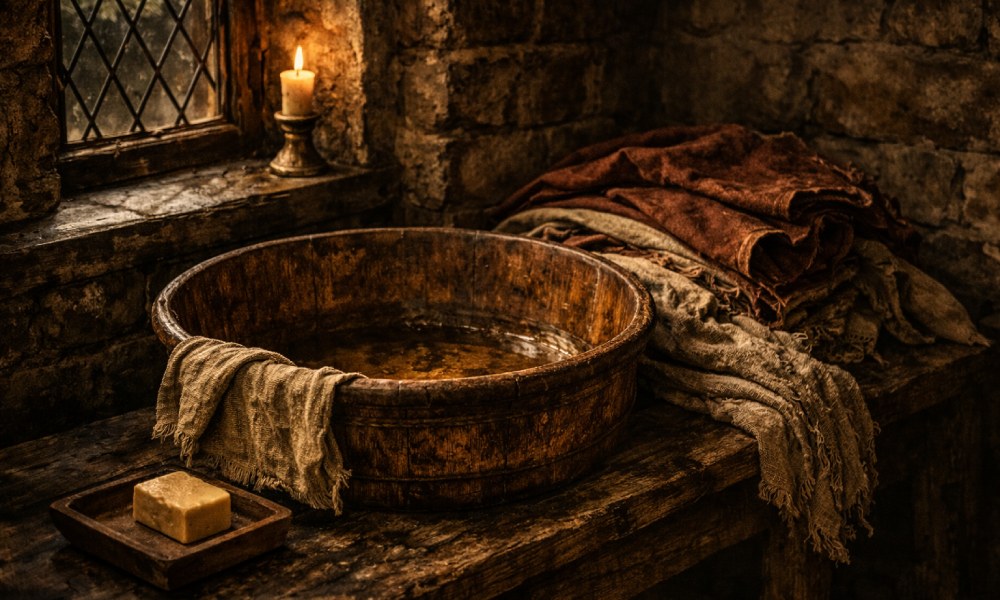
With the decline of the public bath culture of ancient Rome, concepts of cleanliness in medieval Europe underwent a significant transformation. Bathing did not disappear entirely; however, it became more limited and fragmented in practice. The belief that frequent contact with water could be harmful to health gained traction, particularly during periods of epidemic disease.
As a result:
-
Regular bathing practices declined,
-
Cleanliness was maintained through alternative methods (such as changing clothes, dry care practices, and the use of linen garments),
-
Bodily odor became a more visible part of everyday life.
In this context, scent ceased to function as a complement to cleanliness and instead became an indicator of bodily reality and environmental conditions.

Miasma Theory: The Relationship Between Scent and Disease
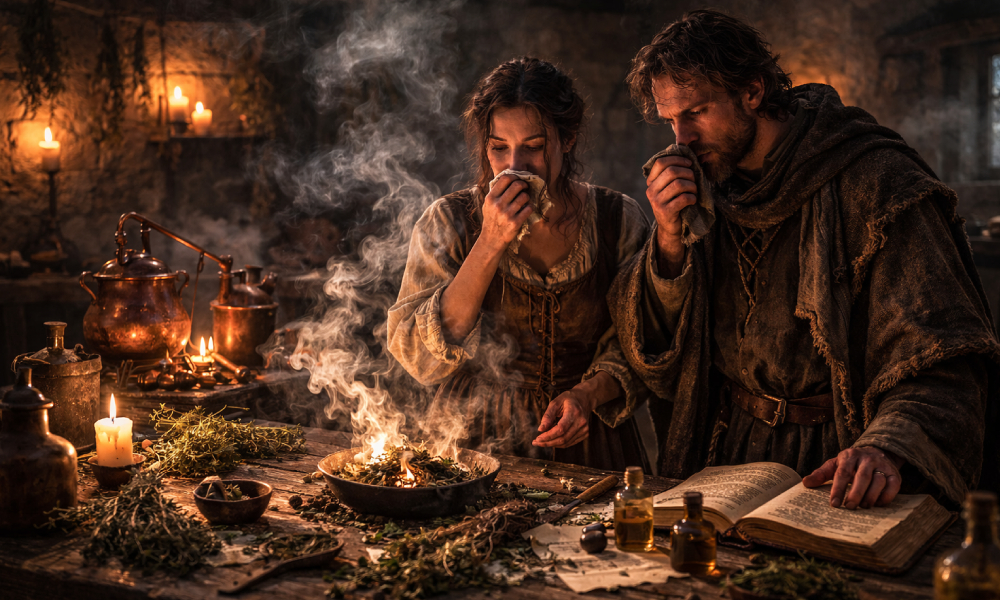
One of the most influential explanations for the spread of disease in medieval Europe was the miasma theory. According to this view, diseases were transmitted through the inhalation of foul-smelling and corrupted air. For this reason, scent was not only a sensory experience but also perceived as a sign of invisible danger. Decaying organic matter, waste, and stagnant, polluted environments were associated with illness, and the odors they produced were considered hazardous.
In contrast, aromatic plants, resins, and spices were used not merely to create pleasant scents, but to “correct” the air or at least reduce its harmful effects. In this context, pleasant scent moved beyond aesthetic preference and became a functional tool associated with health and protection.
For this reason, aromatic substances were:
-
Burned in enclosed spaces,
-
Stored in portable containers,
-
Used individually for inhalation.
Portable Scent Objects: The Pomander
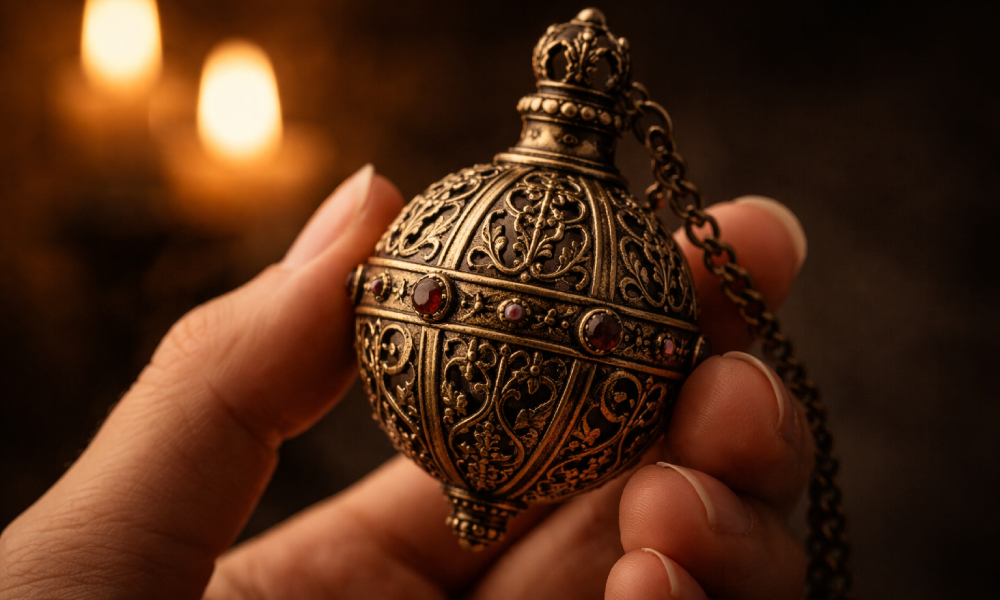
One of the characteristic forms of scent use in medieval Europe was the portable scent object, most notably the pomander. These small containers, filled with mixtures such as musk, amber, resins, and spices, were carried on the body—worn around the neck, held in the hand, or attached to belts.
The primary function of the pomander was:
-
To emit a pleasant scent,
-
And to provide personal protection against foul air.
In this way, scent became a tangible and portable form of individual protection.
Production Knowledge and Chemical Continuity
The distillation techniques and chemical knowledge developed in the Islamic world had a limited and fragmented impact in medieval Europe. Perfume production did not disappear, but it continued through local and traditional practices rather than systematic theoretical development.
In this period:
-
Oil-based and simple mixtures remained in use,
-
Distillation did not become a widespread production method,
-
Scent production remained at the level of craft rather than experimental chemistry.
Thus, scent existed less as an object of knowledge production and more as a sustained practical habit.
Conclusion: A Functional and Regulated Scent Culture
While scent in the ancient world functioned as an aesthetic extension of the body, and in the Islamic world as a field of technical and chemical knowledge, in medieval Europe it moved away from both axes and became a more functional, limited, and context-dependent practice.
In this period, scent was:
-
Morally evaluated,
-
Associated with disease,
-
And largely subject to control.
Medieval Europe therefore represents a transitional phase in which scent was redefined not as an aesthetic expression, but in terms of meaning and function.
Source
Editor: Öykü Nur YÜCE
Classen, C., Howes, D., & Synnott, A. (1994).
Aroma: The Cultural History of Smell. Routledge.
Corbin, A. (1986).
The Foul and the Fragrant: Odor and the French Social Imagination. Harvard University Press.
Le Guérer, A. (2002).
Scent: The Mysterious and Essential Powers of Smell. Kodansha International.
McHugh, E. (2012).
Perfume: From Ancient Egypt to the 21st Century. Random House.