




When Scent Descended to the Body: Oil, Bathing, Social Meaning, and Chemistry in Ancient Greece and Rome
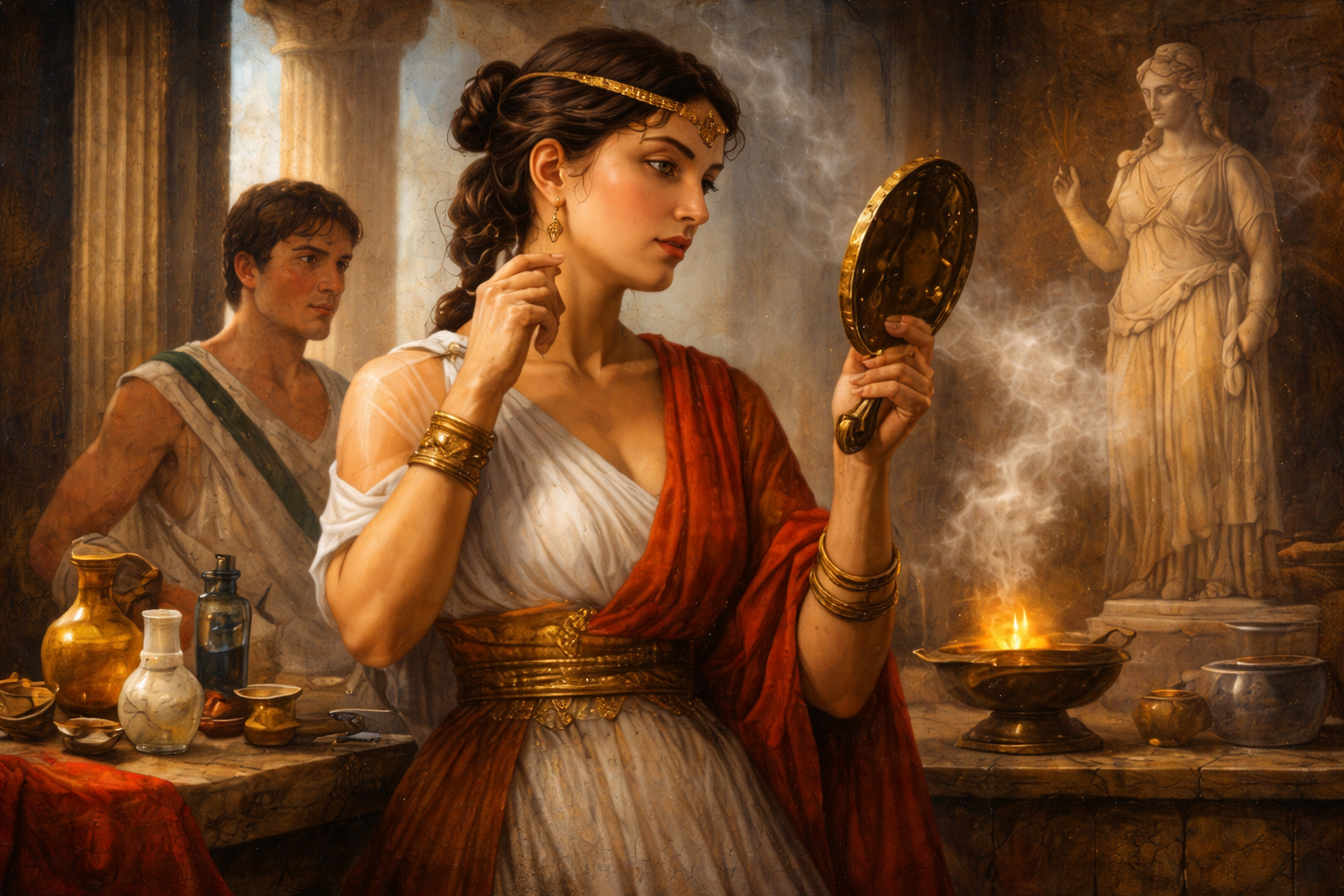
In Ancient Egypt, scent rose toward the gods through smoke. In Ancient Greece and Rome, however, it changed direction. It no longer ascended upward but flowed toward the body. Incense continued to burn in temples, yet the dominant form of scent in everyday life was no longer smoke, but oil. Perfume thus moved beyond the boundaries of ritual and began to engage with the body, social life, and cultural identity.
This period marks a threshold in which scent gained meaning not only through how it was burned, but also through how it was carried and who used it.
The Culture of Oiled Fragrance: The Emergence of Unguentum
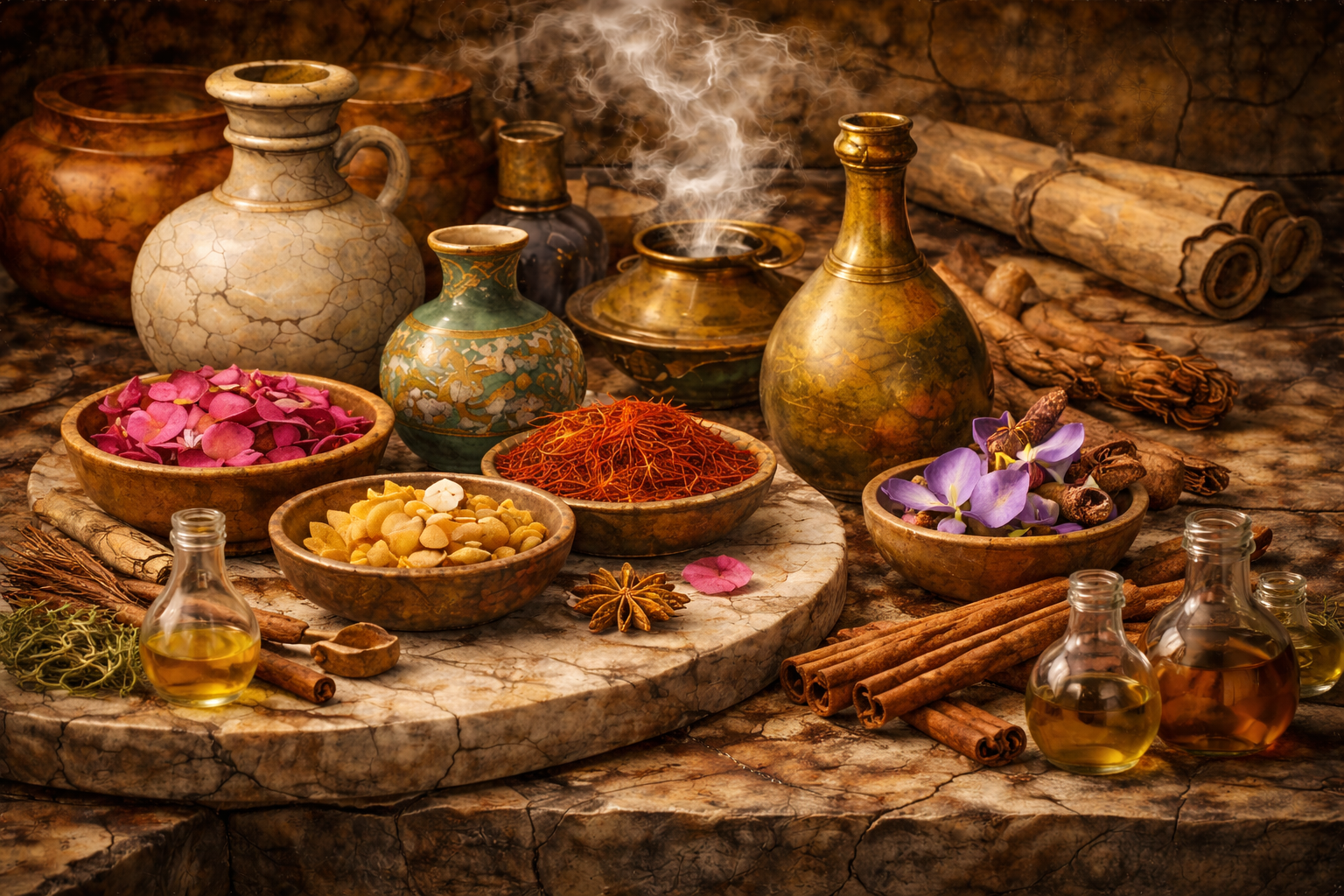
In the ancient Greek and Roman world, the primary form of fragrance was unguentum. It consisted of oil-based mixtures enriched with aromatic plants. Alcohol had not yet emerged as a carrier. Instead, olive oil was the principal medium that bound scent to the skin. This oil was infused over long periods with aromatics such as iris root, rose petals, saffron, cinnamon, and nard.
Scent now spoke not only through what it was, but through how it was presented. Alabastra, aryballoi, and small glass vessels were not merely containers for storage. They also functioned as markers of status, taste, and cultural belonging. The material vessel of scent became an extension of its social meaning.
At this point, perfume quietly but unmistakably acquired a personal language.
From the Bathhouse to the Street: Fragrance After Cleansing
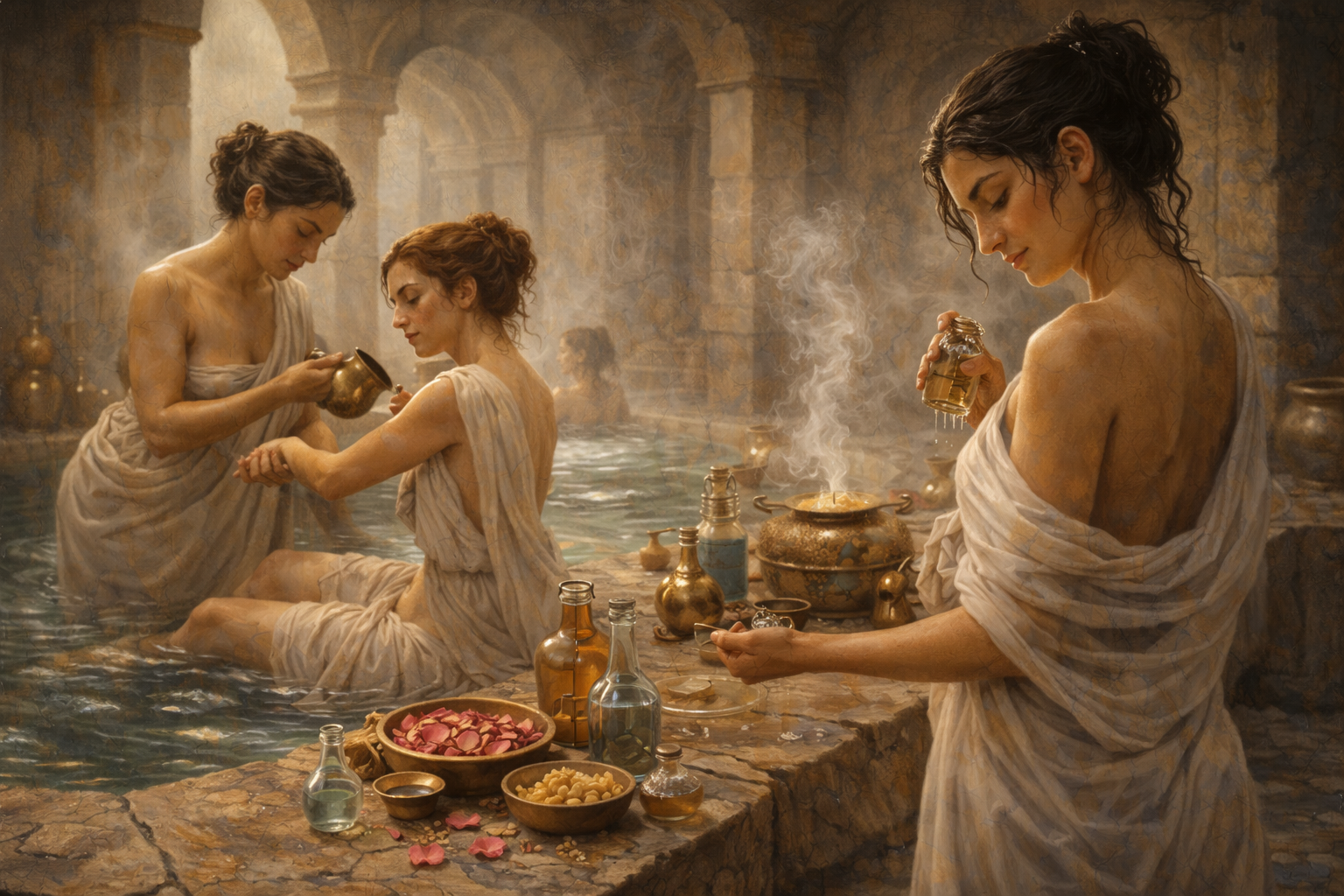
In Roman society, scent became institutionalized most clearly within the culture of the bathhouse. Thermae were not simply places of washing. They were central spaces of social life. Within these settings, the body was treated according to a structured rhythm. Sweating came first, followed by scraping with the strigil, washing, oiling, and finally scenting.
Here, a crucial distinction emerges. Fragrance was not used to conceal dirt, but to complete a cleansed body. This concept can be seen as an early precursor to the modern practice of applying perfume after bathing.
Scent thus became a final gesture that reconfigured the body. For this reason, understanding perfume in the Greco-Roman world requires not only cultural analysis, but also attention to the production logic that made this culture possible. In this period, scent was not something that rose through fire. It was something that adhered through a carrier.
Scent and Chemistry: How Perfume Was Produced in the Greco-Roman Workshop
Perfume production in Ancient Greece and Rome did not follow the model of modern bottled fragrances, which are often imagined as an alcoholic solution combined with a fragrance concentrate. Instead, the fundamental chemical principle was the transfer and retention of aromatic compounds within a carrier phase. This carrier was most often oil, since many aromatic components extracted from plants preferentially migrate into an oily medium.
As a result, the core technology of ancient perfumery was not distillation. It was the controlled infusion of scent into oil and the stabilization of the resulting mixture.
1) Preparing the Carrier: Oil That Accepts Scent
Perfume could not be created simply by adding raw materials. The oil itself had to be treated so that it could retain fragrance. Practical knowledge in this process rested on two key principles.
Control of heat and time: Heat accelerates the transfer of aromatic compounds into the oil phase, but it can also damage delicate floral notes. Production was therefore shaped by careful calibration of temperature and duration.
Layered enrichment: Achieving a strong fragrance often required not a single infusion, but repeated enrichment of the same oil with successive batches of fresh material.
At this stage, perfume ceased to be merely the scent of a plant. It became the scent of a process.
2) Production Technique: Infusion, Straining, and Reinfusion
The workshop practice followed a simple yet highly effective cycle:
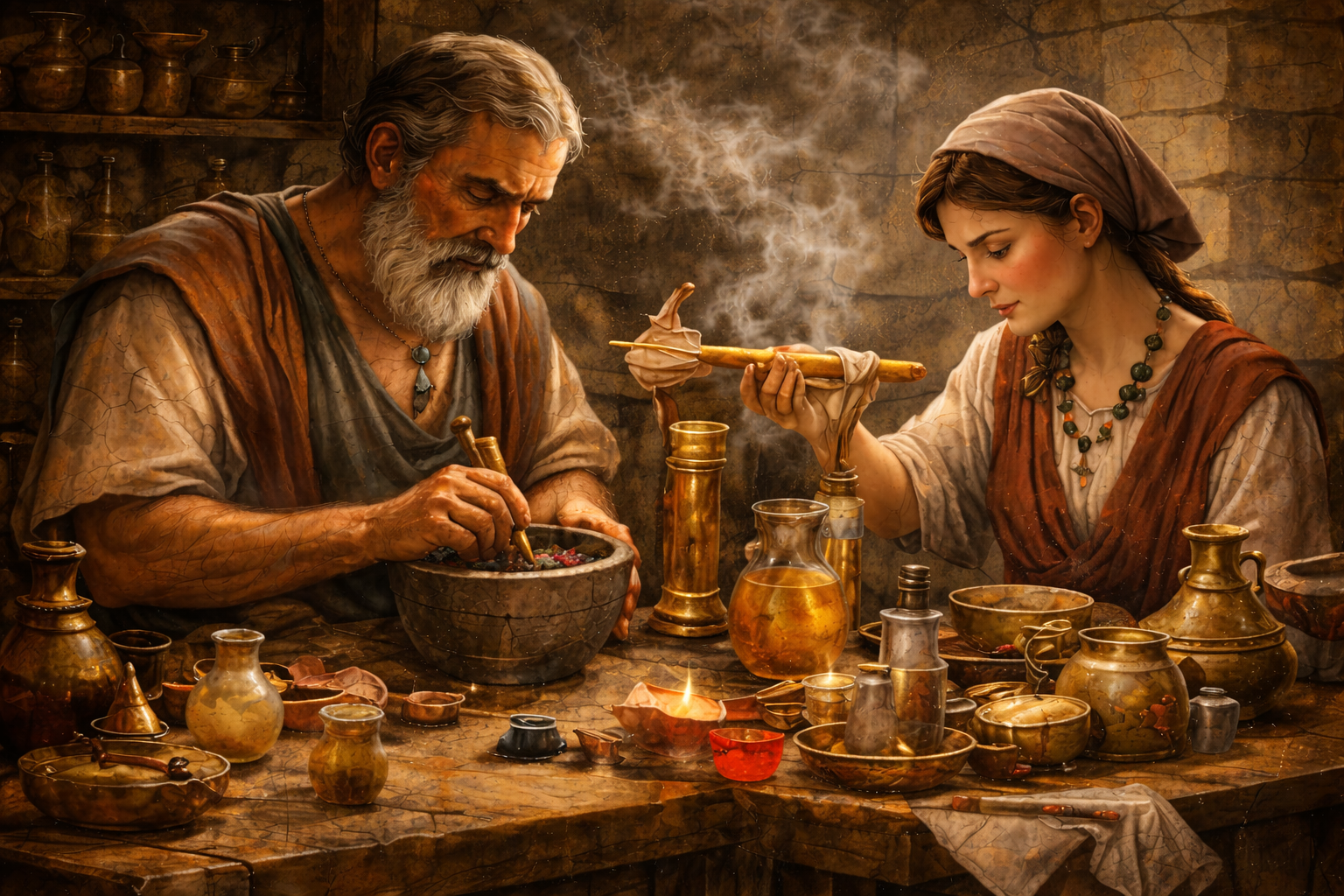
Aromatic plants, flowers, or resins were crushed or broken to increase surface area.
They were brought into contact with oil through soaking and, when needed, heating.
The mixture was strained to separate liquid from residue.
For greater intensity, the same oil was reinfused with fresh material.
In modern terms, this represents a form of extraction logic, though the solvent was oil rather than alcohol. The result was a fragrance that released more slowly on the skin. Aromatic compounds dispersed within the oil unfolded gradually through body heat.
3) Tools of the Ancient Workshop: A Kitchen That Functioned Like a Laboratory
This production logic reveals that a sophisticated fragrance culture was built not on advanced instruments, but on the right tools combined with repetition. The ancient perfumer’s toolkit typically included the following.
Mortar and pestle for crushing botanicals and resins
Heating vessels and cauldrons for controlled warming of oil
Strainers or cloth filters for clarification
Sealing and storage solutions to protect from air, light, and heat, since the container material and the reliability of its closure mattered as much as the fragrance itself
Bottles and small vessels, such as unguentaria, for transport and presentation
For this reason, ancient perfumery was an atelier of processes rather than bottles. It relied on a cycle of crushing, heating, straining, resting, and reinfusing.
4) Distillation Existed, but Was Not the Primary Driver
In late antiquity, alchemical traditions introduced ideas and apparatus related to distillation. However, everyday perfumery in the Greco-Roman world remained firmly grounded in oil-based production. Distillation would emerge as a central technological breakthrough only later, particularly in the Islamic world.
This distinction is crucial. Greece and Rome represent a threshold where scent began to approach chemistry, yet continued to rely primarily on oil and procedural knowledge.
The Limits of Excess: Scent and Moral Judgment
In ancient Greek and Roman texts, scent appears as a deeply ambivalent symbol. Moderate use was associated with refinement and cultural sophistication. Excessive fragrance, by contrast, signaled decadence, luxury, and moral weakness. Scent thus functioned not merely as a sensory experience, but as a practice subject to social judgment.
Perfume ceased to be a silent language and became a behavior open to evaluation.
The Scented Map of the Mediterranean: Trade and Formula Knowledge
Greece and Rome were not the primary sources of aromatic raw materials, yet they became central hubs for processing and meaning-making. Nard arrived from distant regions. Cinnamon and cassia came from farther east. Resins moved through Arabian trade routes. The Mediterranean thus formed a vast circulation zone in which scents converged.
This circulation transported not only materials, but knowledge. It spread practical understandings of how plants should be processed, which carriers retained scent most effectively, and which formulations proved more enduring. Perfume was no longer merely religious or personal. It became an economic and commercial commodity.
Sources
Bradley, Mark. Smell and the Ancient Senses. London: Routledge, 2015.
Casson, Lionel. The Periplus Maris Erythraei: Text with Introduction, Translation, and Commentary. Princeton: Princeton University Press, 1989.
Fagan, Garrett G. Bathing in Public in the Roman World. Ann Arbor: University of Michigan Press, 1999.
Miller, J. Innes. The Spice Trade of the Roman Empire, 29 B.C. to A.D. 641. Oxford: Oxford University Press, 1969.
Pliny the Elder. Natural History. Translated by H. Rackham (and others). Loeb Classical Library. Cambridge, MA: Harvard University Press, 1938.
Yegül, Fikret K. Baths and Bathing in Classical Antiquity. Cambridge, MA: MIT Press, 1992.