




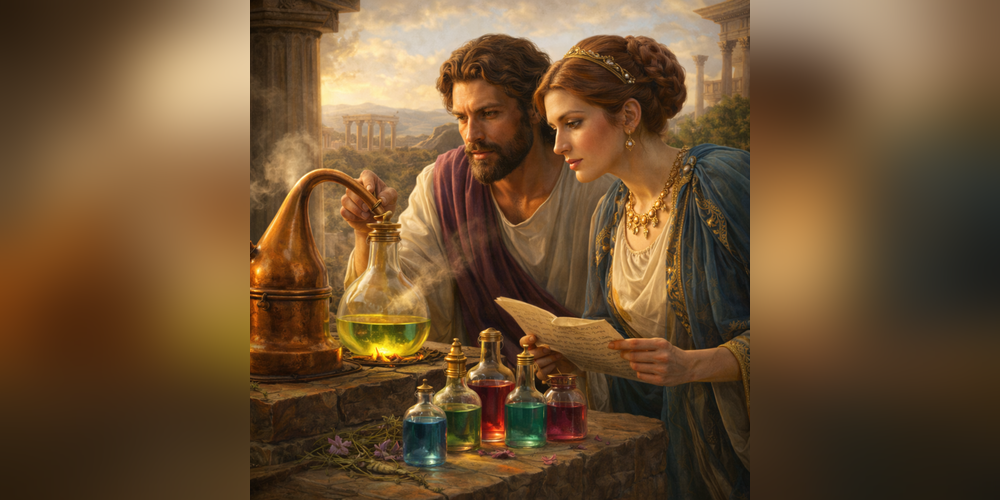
In the Greco–Roman world, fragrance had become as much a part of bodily routine as it was of temple smoke. Oils carried scent; the skin dispersed it into daily life. Yet a fundamental limitation remained: fragrance was still a mixture. It was burned, infused into oils, blended, but not separated into its constituent parts and obtained individually. Scent was an observed phenomenon, not a substance dissected into components.
This limitation begins to loosen in Late Antiquity. Fire-driven vessels, condensing vapors, dripping liquids… Fragrance is not yet the objective, but a culture of experimentation with matter has emerged. This legacy would find a new context, a new purpose, and a far more systematic expression in the Islamic world.
Chemistry Note
The key rupture here is not the “discovery of a new scent,” but the emergence of the idea of separation. Rather than observing how a component behaves within a mixture, the aim becomes extracting that component from the mixture itself. This is one of the most fundamental reflexes of modern chemistry.
Late Antique Heritage: Fire, Vessel, and the Idea of Separation
The alchemical tradition that developed especially along the Alexandrian line in Late Antiquity was concerned less with fragrance than with material transformation. Yet this concern opened a critical door for the history of perfume: the idea of separation. For the first time, the processes of heating a substance, observing vapor formation, allowing that vapor to condense elsewhere, and collecting it in a different form were consciously tracked.
At this stage, the goal was not to obtain pleasant scents, but concepts such as purity, essence, and transformation. Still, the tools employed—vessels, tubes, cooling surfaces—formed the technical foundation of a method that would later sit at the very center of perfume history. This knowledge did not vanish; it was transmitted.
Chemistry Note
The heating–condensation cycle does not operate to “intensify” scent, but to transport it through phase change. Volatility, at this point, ceases to be merely a sensory observation and becomes an exploitable property: what can evaporate can be separated, and what can be separated can be collected.
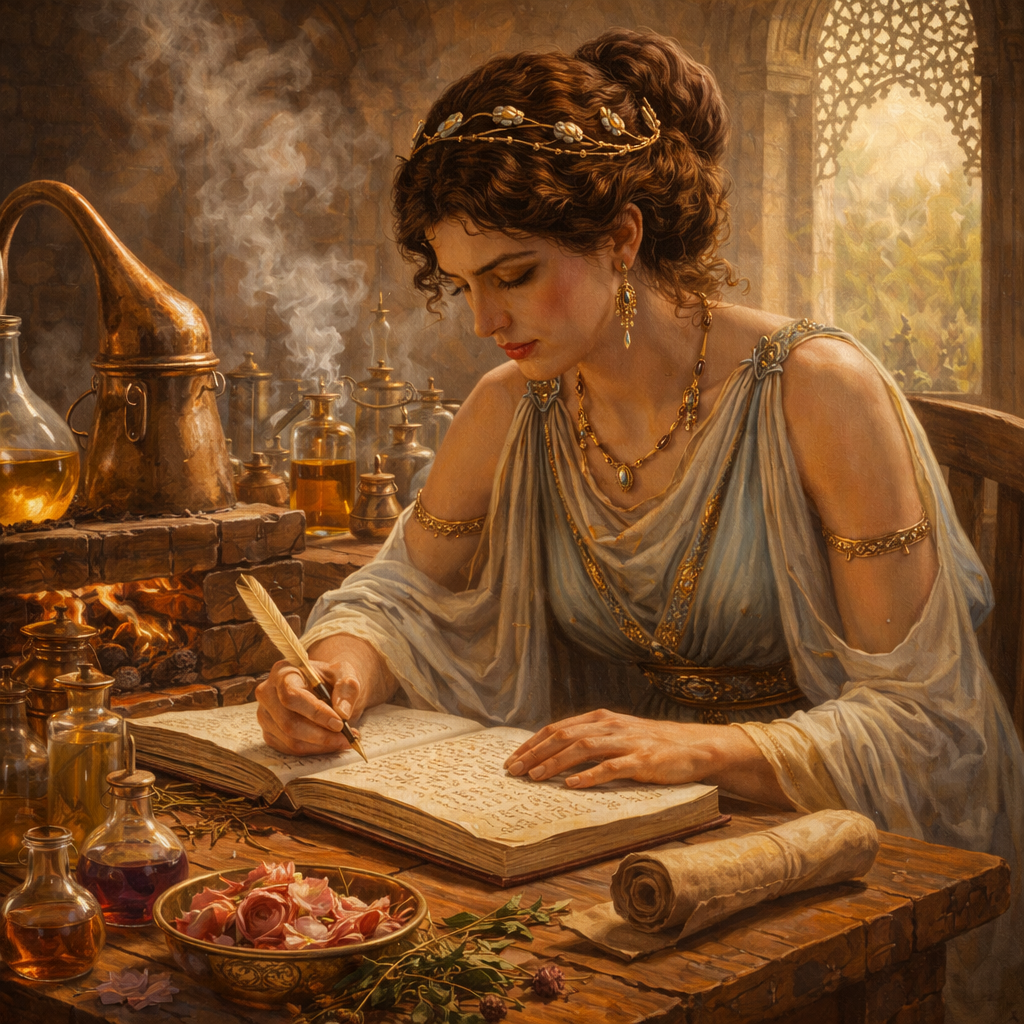
Translation and the Laboratory: Knowledge Rebuilt in a New Context
Between the 8th and 10th centuries, the translation movement in the Islamic world did more than preserve the scientific legacy of Ancient Greece and Rome; it reworked it. Along with texts came methods, instruments, and a culture of experimentation.
Here, a crucial transformation occurs: experimentation shifts from individual curiosity toward laboratory practice. Substances are systematically heated, vaporized, condensed, and collected. Fragrance begins, for the first time, to emerge as a conscious objective.
The intellectual ground of perfume history also changes at this point. Scent is no longer merely a cultural object or ritual signifier; it becomes a material subject to manipulation. What determines the fate of fragrance is no longer only “which plant,” but also “which apparatus” and “which process.”
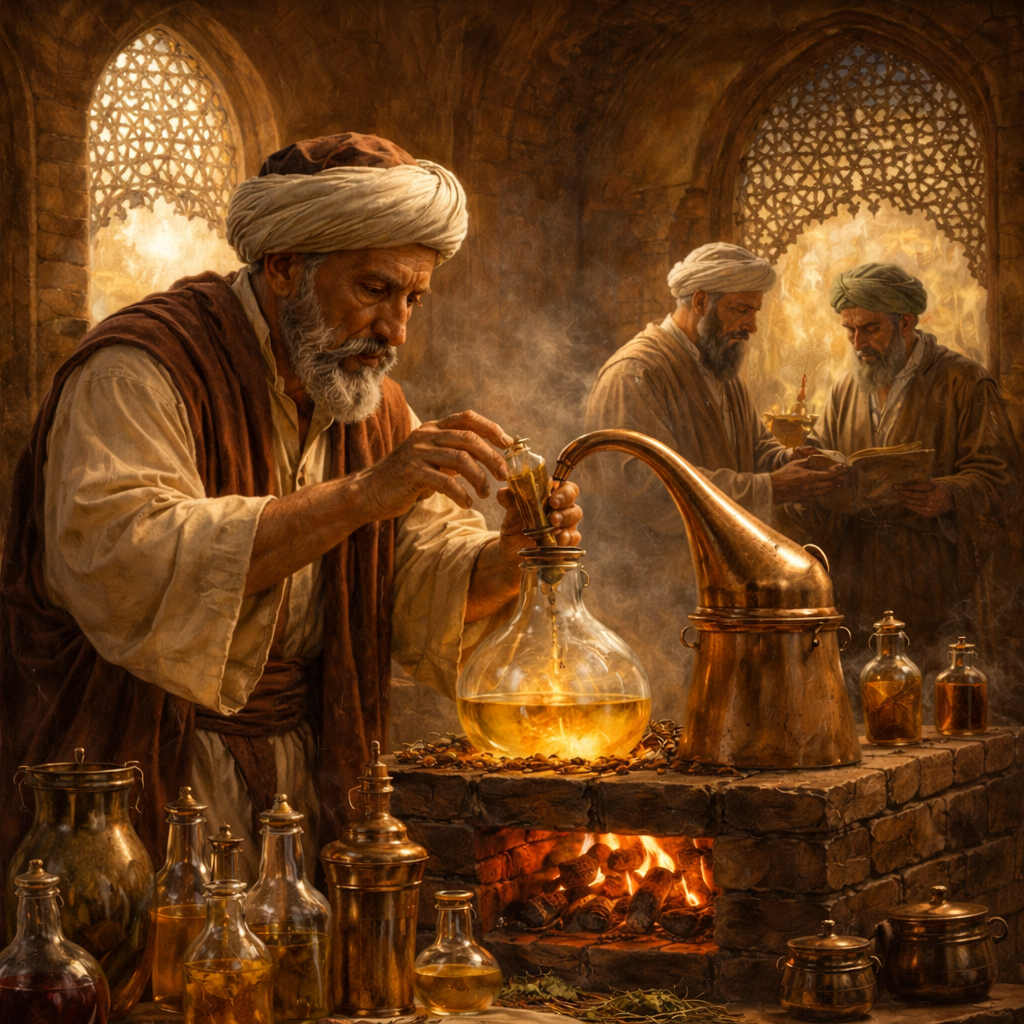
The Emergence of Distillation: Scent Is Separated for the First Time
In the Islamic world, distillation marks a turning point in the history of perfume. With this technique, fragrance is no longer obtained through burning or oil infusion, but through separation. In hydrodistillation, plants are heated together with water; volatile components are carried by steam and then condensed and collected.
Here, scent becomes something that can be captured. Volatility is no longer an intuitive observation but a managed property. As temperature, duration, and condensation surfaces are controlled, the resulting aromatic liquid becomes more consistent.
This marks a clear threshold in perfume history:
Scent is liberated from fire, detached from oil, and treated as a substance in its own right.
Chemistry Note
Hydrodistillation’s reliance on water is not incidental. Water vapor co-distills volatile components and partially buffers plant tissues against excessive heat. As a result, certain aromatic compounds can be transported without burning or degradation; scent emerges from the shadow of combustion and becomes collectable.
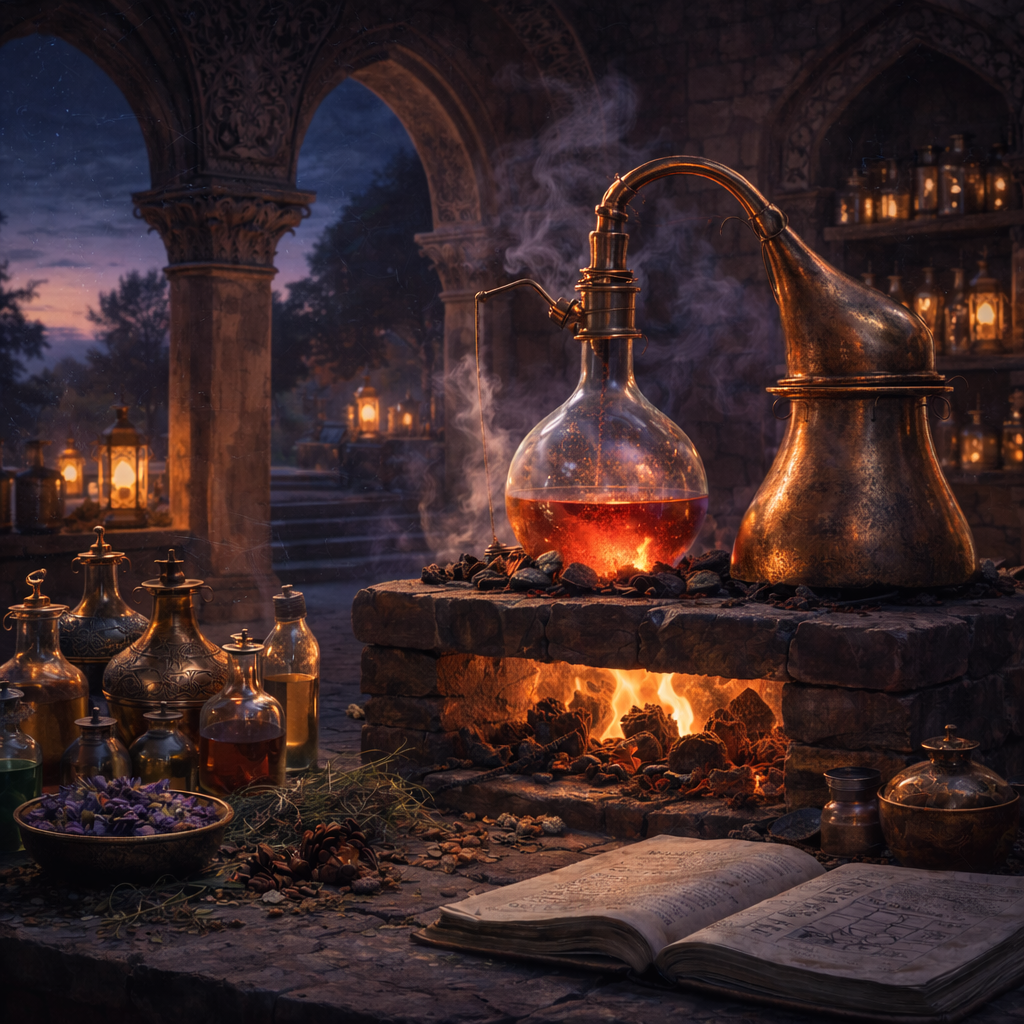
The Alembic and New Instruments: The Materialization of Chemistry
The emblem of this transformation is the alembic. Composed of a heating vessel, a vapor pathway, and a condensation chamber, this apparatus is not merely a tool but a new way of thinking. Matter becomes something that can be decomposed, separated, and recombined.
The production of rose water and attars spreads during this period. The rose, in particular, is an ideal raw material both symbolically and technically: sufficiently volatile, yet resilient under distillation. The resulting aromatic waters find cosmetic, medicinal, and cultural applications.
Scent thus becomes transparent for the first time: its color, density, and aroma can be observed, compared, and evaluated.
Chemistry Note
For the first time, fragrance becomes a measurable product. Questions of quantity (how much is collected), process (how long it is heated), and reproducibility (can the same result be achieved again?) enter the discourse. This shifts perfume from a purely cultural object toward a gradually standardizable product.
Scent and Chemistry: From Behavior to Component
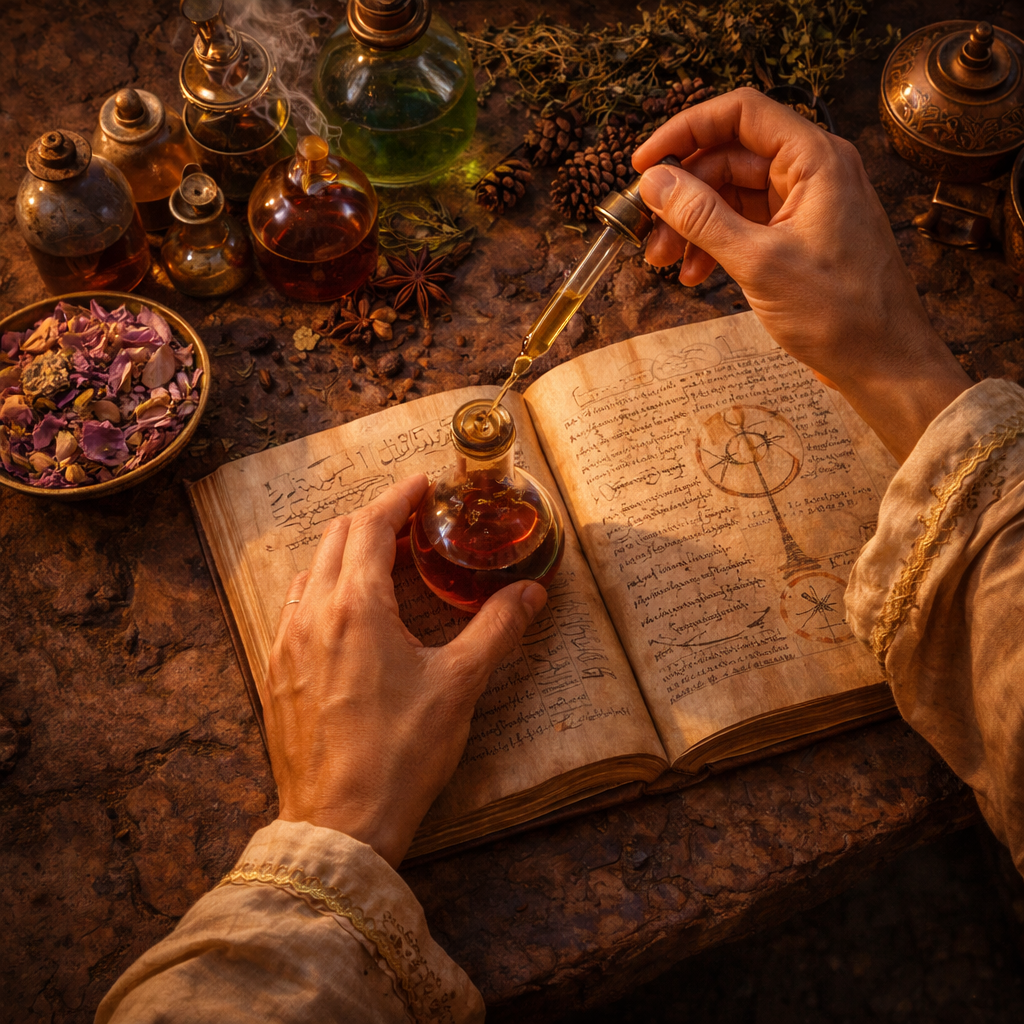
At this point, the bond between perfume history and chemistry becomes explicit. In the ancient world, scent was understood through its behavior; in the Islamic world, it is approached through its components. The volatile fraction is separated; the fixed residue is left behind. This distinction forms the core logic of modern fragrance chemistry.
Chemistry Note
Distillation enables the controlled separation of volatile components. This marks the moment in perfume history when scent ceases to be dependent on a carrier and is instead treated as an independent phase.
The Road to the Bottle Passes Through the Laboratory
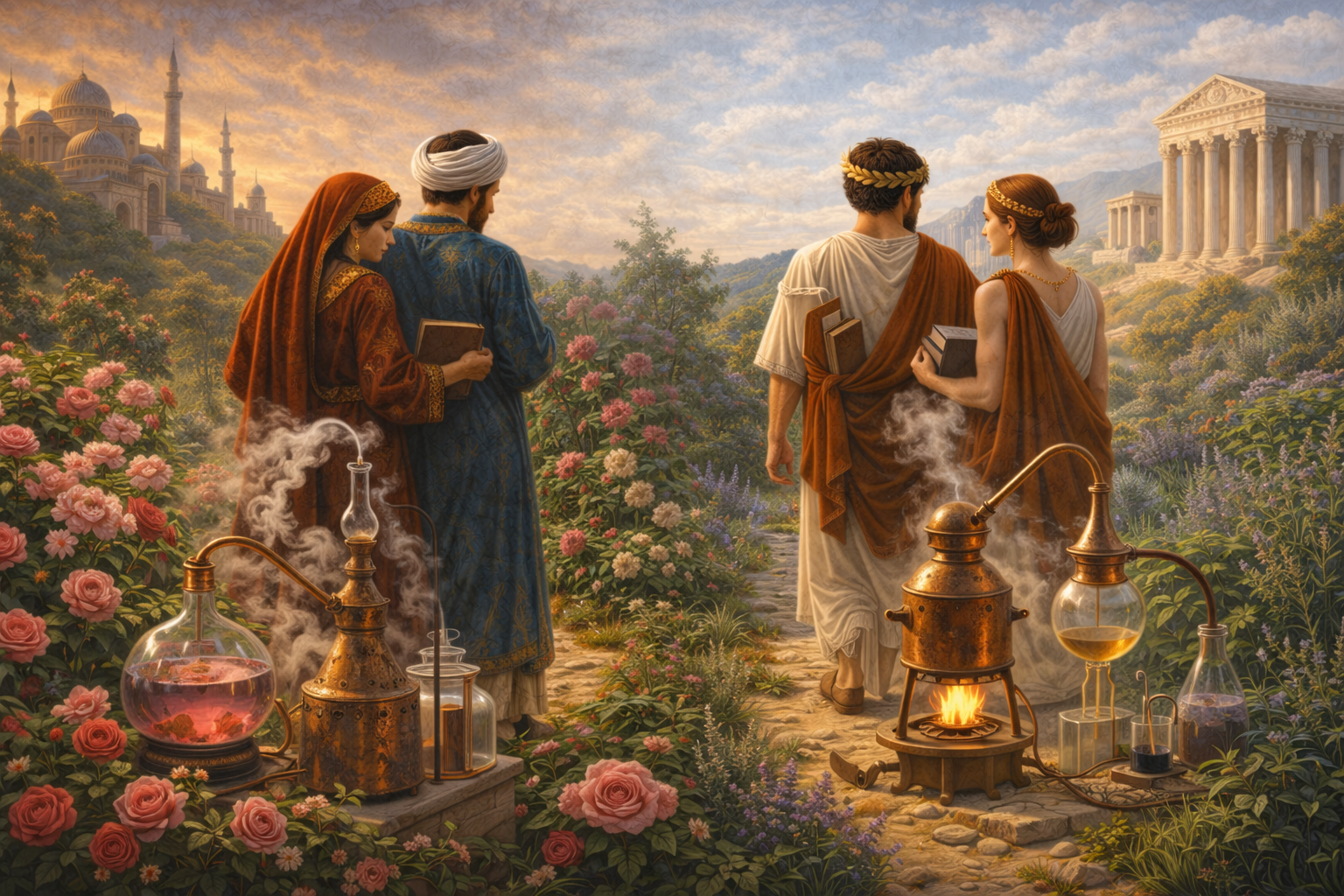
In Ancient Egypt, scent rose as smoke. In Ancient Rome, it clung to the body through oil. In the Islamic world, scent learned to separate. This is the prerequisite of modern perfumery. For what enters the bottle must first be separated, condensed, and rendered definable.
From this point onward, perfume will increasingly become not merely a cultural artifact, but a chemical product.
In the next stage, this knowledge will travel to Europe; alcohol will enter the scene as a solvent, and perfume will approach the “modern” form we recognize today.
Source
- National Library of Medicine (NLM) – Islamic Medical Manuscripts: Alchemy
- Science History Institute – Al-kimiya: Notes on Arabic Alchemy
- Encyclopaedia Britannica – Alembic
- J-STAGE (peer-reviewed article) – Al-Kindī’s Attack on Alchemy and His Perfume Making
- TDV İslâm Ansiklopedisi – Koku
- TDV İslâm Ansiklopedisi – Simya
- Bilim ve Teknik (May 2012). Chemistry in the Islamic World. TÜBİTAK.
- Kaya, D. & Günç Ergönül, P. (2015). Methods for Obtaining Essential Oils. Gıda Dergisi, 40(5), 303–310.