






In stereochemistry, molecules that exist as non-superimposable mirror images are termed enantiomers, and the phenomenon itself is defined as chirality. While standard synthetic chemical reactions yield equal proportions of both mirror forms (racemic mixtures), terrestrial biology strictly requires single-handedness: proteins rely almost exclusively on left-handed amino acids, and nucleic acids incorporate right-handed ribose sugars.
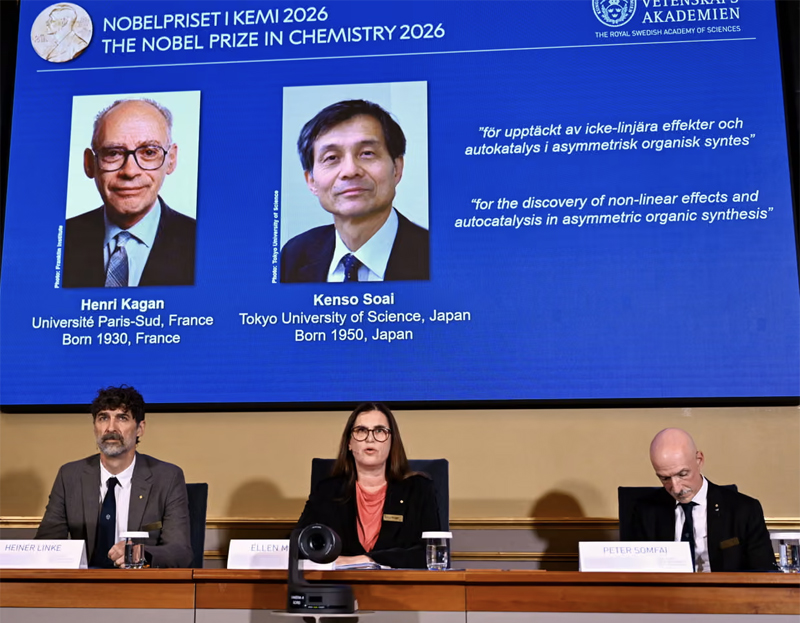
The 2026 Nobel recognition honors Kagan and Soai for deciphering how negligible molecular imbalances amplify into absolute single-handed dominance, addressing both the origins of prebiotic evolution and scalable chiral manufacturing.
Non-Linear Effects and Autocatalytic Amplification
The core scientific milestones established by the laureates comprise:
Kagan’s Non-Linear Effects (1986): Henri B. Kagan dismantled the assumption that enantiomeric purity in a catalyst strictly correlates linearly with the optical purity of the product. Demonstrating that catalysts interact dynamically with multiple chiral ligands, he proved that minor initial chiral imbalances could produce disproportionately high enantiomeric excesses in final reaction products.
The Soai Reaction and Asymmetric Autocatalysis (1995–2003): Kenso Soai discovered asymmetric autocatalytic systems where the product itself functions as a chiral catalyst for its own formation. In landmark experiments, Soai demonstrated that an initial enantiomeric excess as low as 2%—or even statistical fluctuations—could amplify autonomously to exceed 99.99% single-handed optical purity, providing an experimental blueprint for how molecular asymmetry first originated on early Earth.
Applications Across Pharmaceuticals and Functional Chemistry
Precise enantioselective synthesis remains essential across modern industrial manufacturing. Historically underscored by the thalidomide tragedy of the 1960s—where one enantiomer acted as a sedative while its mirror counterpart induced severe teratogenic birth defects—pharmaceutical chemistry requires absolute stereochemical purity.
The methodologies pioneered by Kagan and Soai serve as operational benchmarks for synthesizing targeted small-molecule drugs, agrochemicals, specialized fragrances, and advanced optical materials without reliance on complex racemate separation steps.
Biographical Details
Henri B. Kagan: Born in 1930 in France; completed the majority of his academic and research career at Université Paris-Sud.
Kenso Soai: Born in 1950 in Hiroshima, Japan; conducted his groundbreaking autocatalytic research at the Tokyo University of Science.